
Direct air capture (DAC) is often talked about as a promising but distant and expensive climate solution. Unlike carbon capture at a power plant or factory, which pulls CO₂ from a concentrated exhaust stream, DAC pulls it straight from the surrounding air, addressing historic emissions already in the atmosphere rather than just new ones at the source.
But scale remains one of the biggest barriers to commercialising it. Most DAC technologies get more expensive and energy-intensive as they get bigger.
Decarb-Air, a startup built on research out of UNSW’s School of Chemical Engineering, is trying to prove that doesn’t have to be the case. Its goal is to create a system that captures carbon efficiently and cleanly at any scale, and turns it into low-cost feedstock through algae cultivation.
Solving the problem of feedstock with captured carbon
As industry looks for alternatives to fossil fuel-derived feedstocks for industrial processes, biomass is often held up as the sustainable option. But growing, harvesting and transporting enough of it takes significant land, resources and time.
“We are trying to move away from fossil fuel feedstock into something more sustainable,” says Decarb-Air founder Dr Qiyuan Li. “If we have the technology to capture CO₂ and reuse it, that is a more sustainable way to supply industries that need it.”
Algae proved to be the practical link. It needs a steady, concentrated supply of CO₂ to grow, and DAC can supply that on-site and on demand, without the logistics of trucking in gas or biomass. As an efficient carbon sink, algae take in what would otherwise go to waste and turn it into something useful. “Algae can be used to produce clean energy, as biomass, but also for food, protein powders and vitamins,” Li explains.
The remaining challenge is achieving this efficiently, at scale, and with renewable energy.
Developing the right material and building the right system
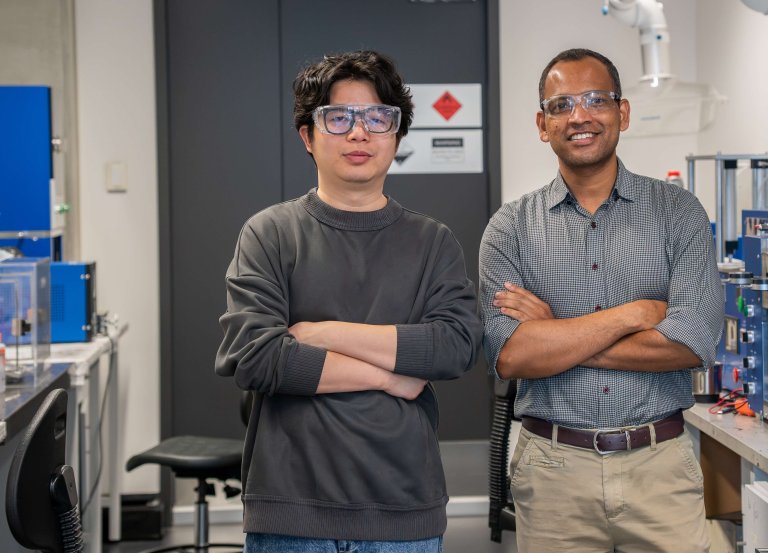
Supported by a TRaCE R&D Voucher, Dr Bingqiao Xie from the PartCat group at UNSW’s School of Chemical Engineering joined the project to help solve that problem, starting with the material that does the capturing.

Capturing carbon straight from the air is a different challenge to capturing it from exhaust system, as ambient air has a much lower concentration of CO₂. An effective DAC system needs to capture CO₂ at low concentrations, release it again using minimal energy, and do so cheaply enough to scale.
With those requirements in mind, the team identified surface-treated solid sorbents as a promising material. Dr Xie’s upcoming work will prepare the adsorbent with the right surface chemical properties for carbon adsorption and test how much carbon it can hold, how quickly it absorbs and releases it, and how well it holds up over repeated use.
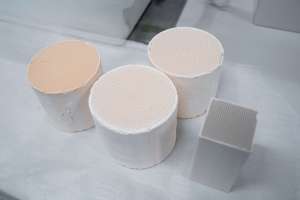
But material alone is only half the problem. It also needs the right structure, which is where Decarb-Air’s honeycomb design is particularly powerful. Current DAC systems push air through packed beds of loose particles, creating air resistance that consumes significant energy. The honeycomb structure is designed to sidestep that trade-off by maximising surface area for capture while keeping airflow resistance low and managing heat more efficiently. The team will test whether these theoretical benefits hold up in practice.
“The concept is promising, but the real challenge is demonstrating that it performs reliably under practical operating conditions. Our role is to develop high-performance adsorbent materials and generate the experimental evidence needed to validate the technology and support its scale-up,” said Xie.
Once the material and structure are validated, the project moves to a system-level demonstration consisting of a compact, solar-powered unit that captures CO2 from the air and feeds it straight to an algae bioreactor. The team will trial this setup at multiple scales, first under controlled lab conditions and then with a live algae culture, to see whether performance holds up in real-world circumstances. The results aim to give Decarb-Air the evidence it needs to move from prototype to a commercially viable product.

What’s next
For Decarb-Air, commercial success comes down to whether the system can be sized to match a customer’s unique needs.
“Every customer’s setup is different, so the system needs to scale up or down without losing efficiency. That’s what we’re building toward, whether it’s a small algae reactor, a greenhouse or a much bigger operation,” says Li.
Decarb-Air is already tapping into the TRaCE ecosystem to find collaborators on similar challenges, including ALBON, a TRaCE-supported startup using algae to treat agricultural wastewater.
It’s a good example of what the ecosystem is built to do: back early-stage ideas with funding and connect researchers and startups solving complementary pieces of the same puzzle. That kind of support is what will help take Decarb-Air’s technology from lab to market.
Expressions of interest for co-funding up to $50,000* through TRaCE R&D Voucher program are still open. If you are a small-to-medium enterprise, start-up or scale-up seeking easy access to co-designed and co-funded R&D projects in recycling and clean energy sectors, learn more and apply here.