Wastewater treatment is one of those costs that never goes away for agri-food operators. It is energy intensive, chemically heavy, and even after significant effort, the remaining nutrient-rich discharge still risks damaging local waterways and ecosystems.
Having seen that challenge firsthand, the co-founders of ALBON set out to build something better: a system that cuts treatment costs and captures the value sitting in wastewater rather than flushing it away.
A closed-loop modular water treatment system
ALBON’s core technology is a modular, solar-powered algae-bacteria photobioreactor designed to integrate into the final stages of existing wastewater treatment infrastructure.
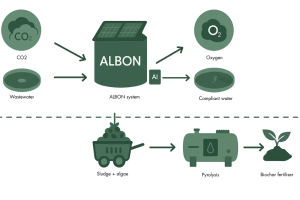
The technology intentionally fights algae with more algae. Agri-food wastewater is typically rich in nitrates and phosphorus, the very nutrients that drive algal blooms. Inside ALBON’s photobioreactors, microalgae consume these nutrients while sequestering CO₂ as they grow.
When harvested, the algae biomass is converted into biochar, a carbon-rich material that improves soil health and water retention. Applied to agricultural land, it has been shown to boost crop yields by up to 20% and reduce reliance on chemical fertilisers.
The result is a closed loop system. Excess nutrients removed from water are locked back into the soil, captured carbon stays out of the atmosphere, and the biochar finds another life as a more sustainable input for farmers, households, and construction industries pursuing green building materials.
Growing fast with the right support
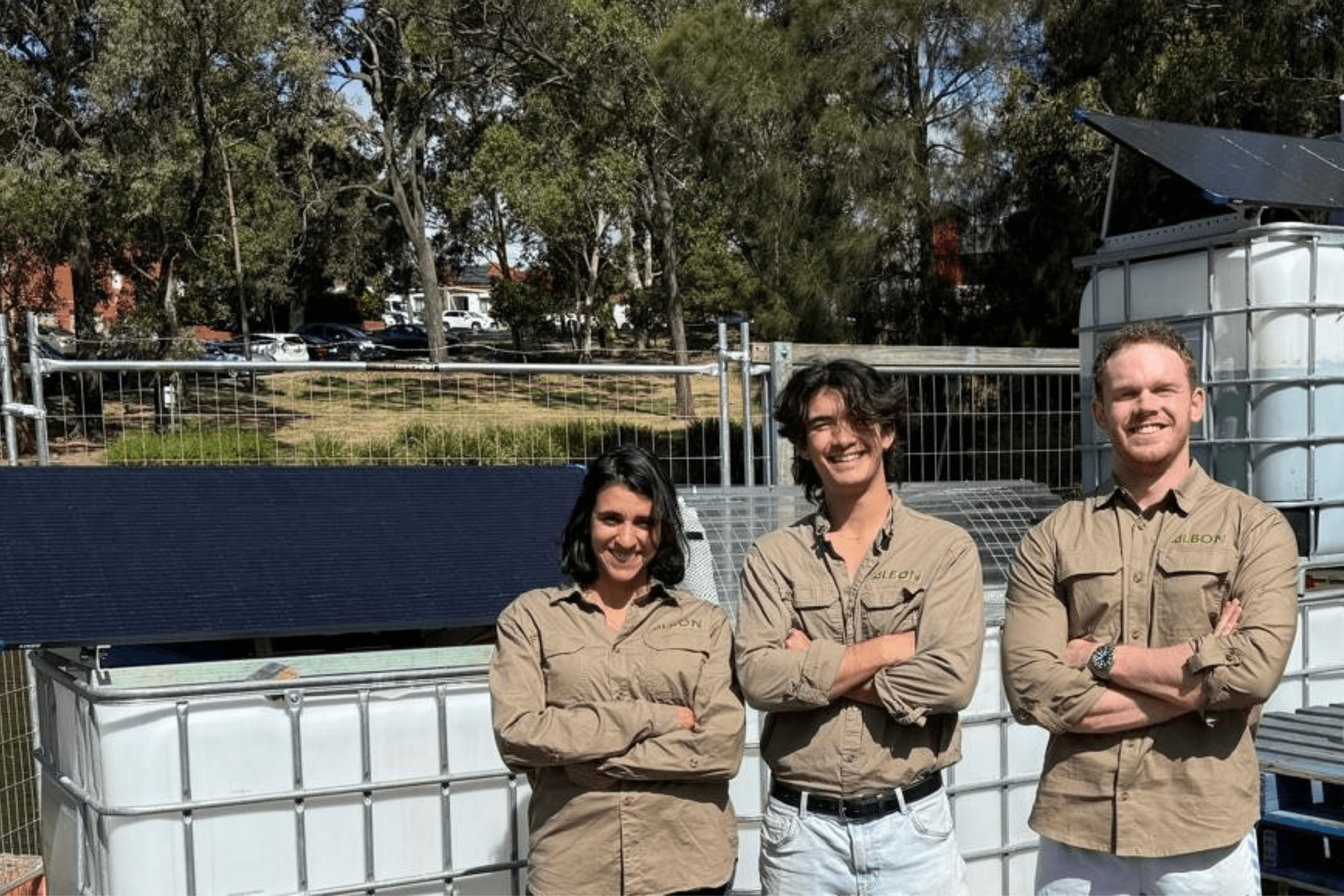
ALBON was founded by John Phipps (CEO), Tom Bessell (CFO), and Dr. Andrea Gonzalez (CTO), and the team has built a strong track record in a short time. They placed second at the MIT Climate and Energy Prize, competed in the Hult Prize global finals in the UK, and have been recognised at the Australian Water Awards, with backing from institutions including the University of Sydney’s Knowledge Hub, INCUBATE, and Startmate.
In late 2024, ALBON partnered with the City of Canterbury Bankstown Council to deploy a photobioreactor at Wiley Park in South West Sydney, targeting nutrient pollution in a local pond. Construction kicked off in early 2025, marking the team’s first full-scale installation and a significant step from lab to live environment.
ALBON joined the TRaCE-supported climate stream of the 2026 Pre-Accelerator (PreX) program at a pivotal moment in their commercialisation journey. The free, four-week initiative run by UNSW Founders gave them a structured space to sharpen their go-to-market approach and stress-test their business model alongside a cohort of fellow climate founders.
“PreX challenged us to step back from the technology and really understand what our customers need,” says John Phipps, Co-Founder and CEO. “The mentors, the networks, and the fellow founders we met through the program have been invaluable as we push toward commercialisation.”
Beyond the program itself, being part of the UNSW ecosystem opened doors the team hadn’t anticipated. Access to deep tech funding pathways, commercialisation expertise, and specialists like a pyrolysis expert who helped validate a core part of their process gave the founders a level of confidence that is hard to find elsewhere.
“We had no idea how vibrant and supportive the UNSW startup community was until we were in it,” Phipps adds.
That experience has only strengthened their ambition. ALBON is now applying to join the Climate 10x Accelerator to keep building on the momentum.
What’s next
Things are moving quickly for ALBON following the success of their Canterbury pilot. The team has recently secured new lab space at the Sydney Knowledge Hub and the University of Sydney’s School of Civil Engineering. They have also signed their first commercial dairy farming customer, bringing their technology onto an active production site for a full pilot. With real-world performance data accumulating and a clear path to further deployment across agri-food industries, the team is planning to raise in early 2027.
If you are interested in supporting ALBON’s technology or exploring a partnership, get in touch.