
Hydrogen peroxide is one of the world’s most versatile chemicals that can be used for disinfection, water treatment and industrial processing. Making it, however, is far from clean. More than 95% of the world’s supply comes from large centralised chemical plants that use a lot of energy, produce harmful waste and carry safety risks. Australia also relies heavily on hydrogen peroxide imports with limited domestic production capability.
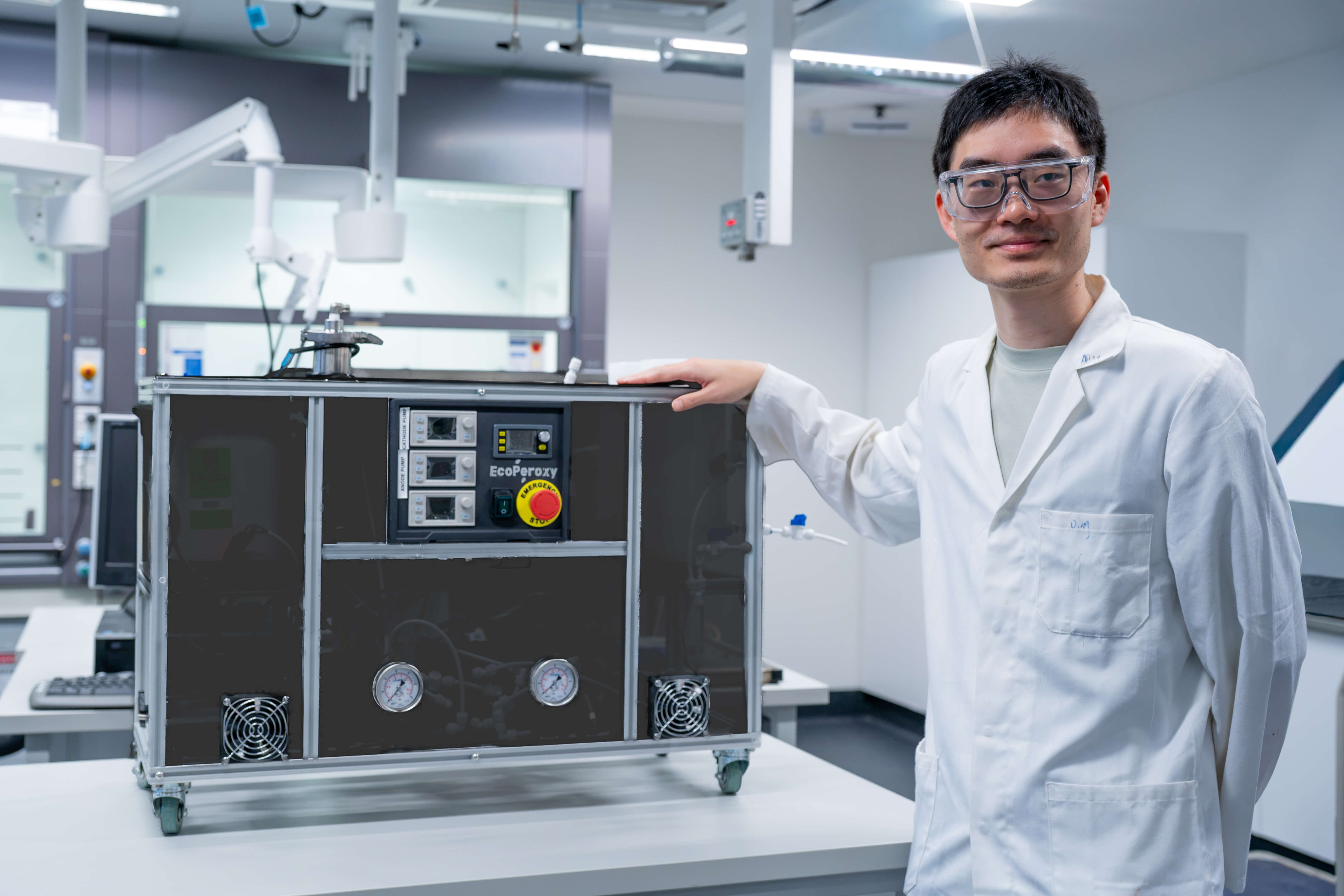
TRaCE-supported startup EcoPeroxy wants to change that. It has built its first working prototype of a plug-and-play system that generates hydrogen peroxide right where it is needed.
From lab bench to first prototype
Two years ago, Dr Ding Zhang from the UNSW School of Chemical Engineering’s Particles and Catalysis Research Group was proving his electrochemical method for making hydrogen peroxide in the lab. It works at room temperature and normal pressure, making it a cleaner and safer process with a much smaller environmental footprint.
Now that method fits in one compact unit that starts producing hydrogen peroxide at the push of a button.
Making hydrogen peroxide directly where it’s needed
“Our value proposition is that we can generate this chemical on site and on demand,” said Zhang.
Built to run on renewable energy such as solar and wind, the system could move production out of centralised plants and onto the sites that use it, with no hazardous chemicals to transport or store. The result is a safer, more sustainable and more cost-effective supply that shields customers from global supply chain disruptions and offers a path to sovereign manufacturing capability for Australia.

Built with TRaCE support
The prototype caps a journey TRaCE has backed since the early research stage. Zhang was TRaCE’s first Enterprise Academic Fellow, receiving salary support to focus on taking his research to market. Along the way, he drew on fast R&D support from TRaCE’s Technology Translation Squad, mentorship from UNSW’s New Ventures team, and UNSW Founder’s Engineering Spinout Fellowship program. In 2025, EcoPeroxy reached the top four of Beanstalk’s Drought Venture Studio, securing $250,000 in funding and a year of ongoing support.
Dr Qiyuan Li joined the project as an engineer, integrating engineering components together into the trial prototype now being tested and refined. He also brings a founder’s perspective. Through his own TRaCE-supported startup, Decarb-Air, which is developing direct air capture technology, he knows first-hand what it takes to get an early-stage product off the ground.
From field trials to scale
“The most important thing for us over the next few months is to deliver this to our trial partner so they can start testing the prototype in real-world industrial applications,” said Zhang. “We really want to know the efficacy of the system out on the field.”
The team is also working to scale up the system’s output, opening the door to higher-demand markets such as food processing and water treatment. Major irrigation and agricultural suppliers have already shown strong interest in the startup’s technology.
“We’ve walked alongside Ding all the way from the lab to a working prototype, and it’s been rewarding to watch him make the most of every program on offer,” said Claudia Kirkpatrick-Just, TRaCE Program Manager. “The next stage is just as important. Field trials and industry partnerships are where a promising technology proves it can deliver real-world impact, and we’re excited to keep supporting EcoPeroxy as it scales.”
Acknowledgements
Ding Zhang would like to acknowledge the Particles and Catalysis Research Laboratories, UNSW Chemical Engineering, TRaCE, Beanstalk, UNSW Founders, Future Food Systems for their support throughout this work.