Decarice is a one-stop service that retrofits existing diesel engines to hydrogen-diesel hybrid engines for immediate CO2 reduction.
Formed to provide services converting existing diesel engines to hydrogen-diesel hybrid engines, DeCarice is a clean energy start-up company founded by Goran Bozic and Professor Shawn Kook. The company aims to transform industries like mining, construction, ports and agriculture where diesel engines contribute a significant portion of greenhouse-gas emissions.

Using a process to retrofit diesel engines for faster emissions reduction, DeCarice’s novel technology allows diesel engines used in power generators, trucks and industrial equipment in industries including transportation, agriculture and mining to be converted to run on 90% hydrogen gas and 10% diesel. Seamless mode switching allows for the engine to run solely on diesel when needed and the existing asset powered by the diesel engine is retained.
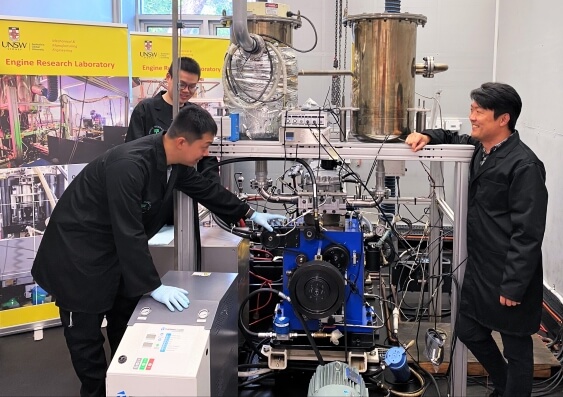
Professor Kook performed experimental research to find an innovative way to enable hydrogen-diesel engine operations at the UNSW Engine Research Laboratory where he is the director.
Craig Peden, a business development manager at UNSW now working with the Trailblazer for Recycling & Clean Energy (TRaCE) saw great commercialisation potential from his very first visit to the lab.
“I could see that Professor Kook was ready to embark on an accelerated entrepreneurship journey.” said Mr Peden. “The work his research team were doing at the lab had already attracted a good deal of interest, especially the Hydrogen-Diesel Direct Injection Dual-Fuel System that had such a significant and immediate impact on emissions reduction.”
“The technology had been tested to the right level and, once patented, could be taken to market successfully. This was a great fit for the Climate 10x accelerator program run by UNSW Founders with support from TRaCE and Virescent Ventures.”
An additional incentive was that Professor Kook possessed the entrepreneurial spirit that exemplifies the cultural change TRaCE seeks to deliver.
“I knew our technology had commercial potential, especially when we saw that our hydrogen diesel hybrid engine was able to reduce CO2 emissions by 77% while achieving the same efficiency, power and emissions,” he said.
Creating a startup from research IP
With a technical background and having worked as a university researcher and professor providing education for many years, Professor Kook felt that he did not have the right knowledge to establish a business.
“The missing element for me was understanding how to create a viable business, attract investment and create a solution for customers,” he said.
“The TraCE initiative is such an exciting opportunity for academic researchers. It is really changing the mindset of academics, encouraging us to be more interested in scaling up our technology and contributing solutions to real world problems. This is a completely different approach to the way research and development is traditionally undertaken in universities,”
– Professor Kook.
While too busy to pursue an MBA or attend business training, Professor Kook realised that participating in an accelerator was a great way for an academic researcher to quickly learn about how to create a business from academic IP.
Taking the technology to market
The Climate 10x accelerator program proved to be incredibly helpful, particularly by connecting Professor Kook and co-founder Goran Bozic to a range of business specialists.
“In commercialising the hydrogen hybrid technology, we are taking important scientific research into real-world situations to reduce our collective carbon footprint,“ Mr Bozic said, adding that the Climate 10x accelerator provided the knowledge, mentoring and motivation for them to find product-market fit and start to plan a viable commercial strategy.
“We’ve extended the momentum out of the accelerator into demonstrator programs with industry partners and funding discussions with investors and are now ready to commercialise this exciting technology!”
The pair is excited by DeCarice’s potential to make a significant difference in reducing global carbon emissions with its high-tech solution that can benefit industry straightaway while also creating manufacturing capability here in Australia.
“We’ve been supported by so many wonderful people and we’re really looking forward to what happens next. We are full of energy and ready to take any challenges,” said Professor Kook.
The Australian market for diesel-only power generators is currently estimated to be worth around $765 million. With the most immediate potential use for the new technology in industrial locations, DeCarice has attracted interest from Australian industrial locations involved with renewable hydrogen production and will soon operate several in-field demonstration projects.
The Hydrogen-Diesel Direct Injection Dual-Fuel System
DeCarice’s patented Hydrogen-Diesel Direct Injection Dual-Fuel System converts diesel engines such as those powering trucks and mining equipment into hydrogen-diesel hybrid engines.What makes this technological system unique is the way hydrogen and diesel are introduced directly into the engine cylinder to fully control the combustion process.
By using 90 per cent green hydrogen derived from clean renewable energy sources such as wind and solar as fuel and mounting the direct injection system into existing diesel engines, DeCarice offers the potential to greatly reduce industrial carbon emissions.
TRaCE is creating a robust ecosystem that de-risks climate technologies
DeCarice has experienced substantial growth through comprehensive support. Initially funded through TRaCE’s R&D Project fund, DeCarice transitioned into a spinout via the TRaCE accelerator Climate 10x, paving the way for Investible’s recent investment. In addition, TRaCE facilitated the funding of an Industry PhD, allowing a commercially focused researcher to be seconded to DeCarice. TRaCE has also enabled two-way secondments between industry partners and researchers, fostering the co-design of solutions that address real-world challenges.
“The full ecosystem has been essential in our journey from lab to market, providing not only capital but also the critical support needed to attract VC funding and drive our growth,” said Goran Bozic, CEO of DeCarice.
Learn more about DeCarice. Get involved in the 2024 Climate 10x accelerator program.