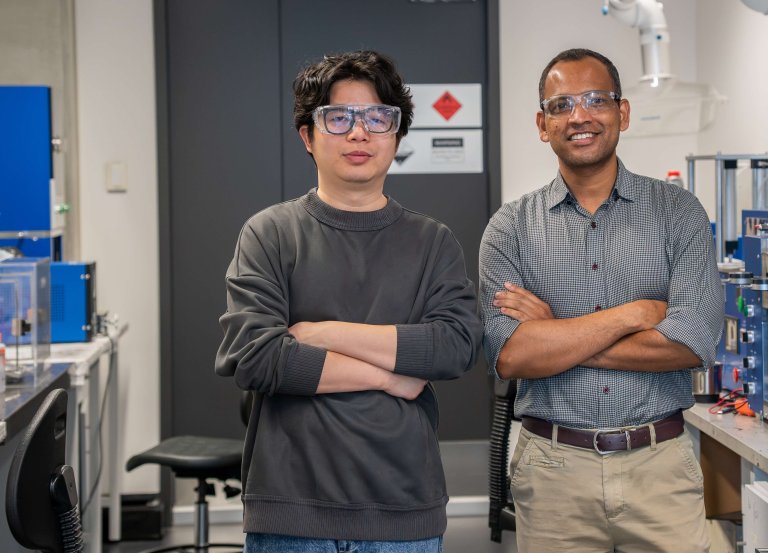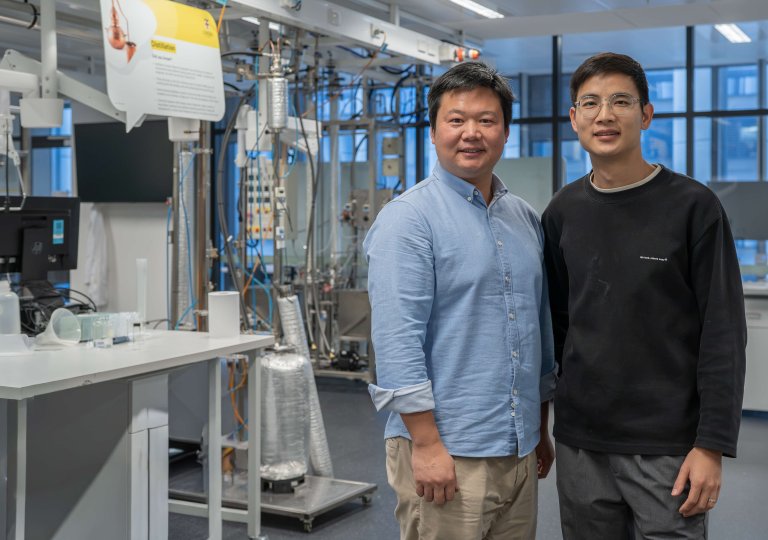

EM Energy was the first recipient of a TRaCE R&D voucher. They used it to undertake a feasibility study on their Organic Hydrogen Electrolyser Cell (OHEC) — a technology capable of producing green hydrogen from any organic waste material, including sugar cane trash, food waste and coal tailings — at the University of Newcastle.
Testing confirmed that the technology could generate pure hydrogen without releasing greenhouse gas emissions. Armed with this data and new technical insights, the EM Energy team were able to quickly develop a working model and move into a larger facility in Mayfield North.
“Once we finished the technology validation project at the University, we started scaling up our organic feedstock,” said Ms Kesha Manimaran, EM Energy Research Assistant.
“We were no longer able to do it at laboratory scale, so we moved into a workshop with a larger hydrogen reactor.”

Photo supplied by EM Energy: Ms Isabel Toasa (Co-Founder and Head of Research, EM Energy) standing with the OHEC prototype.
Co-locating teams for success
But the benefits of partnering with TRaCE did not stop there. EM Energy utilised the TRaCE Mobility Fellowship program to support Ms Kesha Manimaran to work on the project at the University of Newcastle.
“The TRaCE fellowship has enabled us to collaborate closely with the University of Newcastle’s research team by co-locating our teams. This proximity has fostered seamless collaboration, allowing us to efficiently tackle the challenges of developing, testing, and validating new technology,” said Mr Chris Wilson, EM Energy Co-Founder and Director.
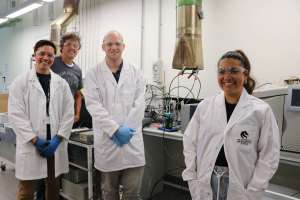
EM Energy and University of Newcastle researchers in the lab. From L-R: Mr Chris Wilson (Co-founder and Director, EM Energy), Dr Daniel Bishop (Research Associate), Dr Peter Richardson (Research lead, University of Newcastle) and Ms Isabel Toasa (Co-Founder and Head of Research, EM Energy).
Ms Isabel Toasa, Co-Founder and Head of Research, and Mr Chris Wilson, Co-Founder and Director, credited the TRaCE team’s support in providing industry exposure and access to research facilities and office space at the University of Newcastle’s Newcastle Institute for Energy and Resources (NIER) as instrumental to their success.
“It allowed us to adapt quickly to data and any challenges that arose throughout the feasibility study,” said Ms Isabel Toasa.
“If we had tried to do this project just by ourselves, it would have taken longer and cost more.”
Accessing an ecosystem of expertise at the University of Newcastle
By connecting with TRaCE’s ecosystem of support across research and industry, EM Energy was among the first to learn about new opportunities to grow their business.
They went on to successfully complete the TRaCE-supported I2N Cleantech Accelerator, making a connection along the way which prompted their move into the new facility.
“Being part of the I2N Cleantech Accelerator gave us more recognition and opportunities to pitch and network with investors. It was a great experience for networking,” said Ms Kesha Manimaran.
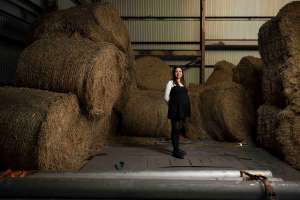
Photo supplied by EM Energy: Ms Isabel Toasa (Co-Founder and Head of Research, EM Energy) standing with hay – one feedstock material for the OHEC.
What comes next
Looking ahead, EM Energy plans to keep testing and improving the system to increase hydrogen output and explore how to utilise the process’ by-products.
“Being in the startup space and watching the progress and challenges of scaling this technology is a unique experience. While it can be a bit challenging at times, it is exciting to be part of something so innovative,” said Ms Kesha Manimaran.
“There is so much to learn, and it is motivating to see how we are moving forward together as a team.”
Partner with us
The TRaCE R&D Voucher program provides small-to-medium enterprises, start-ups, and scale-ups with easy access to co-designed and co-funded R&D projects in recycling and clean energy sectors.
Find out more here.