
Lithium-ion batteries have powered the first wave of the energy storage boom, but their limitations are becoming harder to ignore. Lithium prices continue to fluctuate, and hundreds of lithium-ion battery fires have been recorded in New South Wales alone. For a technology expected to underpin homes, businesses and the grid at massive scale, cost, safety and supply security all matter.
ZenQuo, a UNSW spinout, is developing an alternative. Its aqueous zinc-ion battery (AZIB) is built from some of the safest, cheapest and most abundant materials available: water, zinc, iron and manganese.
Unlike lithium-ion chemistries, AZIBs use a benign water-based electrolyte instead of flammable organic solvents, removing the fire risk of traditional lithium-ion batteries at a chemical level. The cell components are also fully recyclable, supporting a true circular economy approach as the technology scales.
Chasing a high-performing and low-cost cathode
At the heart of ZenQuo’s technology is a cathode material called sodium manganese iron hexacyanoferrate (NMFC), a high-voltage and high-capacity compound built from earth-abundant elements. On paper, it is exactly what a scalable and affordable AZIB needs. In practice, it has a stability problem.
As the battery charges and discharges, the manganese atoms in the cathode shift shape slightly each time. Over many cycles, that repeated shifting known as the Jahn-Teller effect, causes manganese to slowly leach out of the material and the battery’s capacity fades with it.
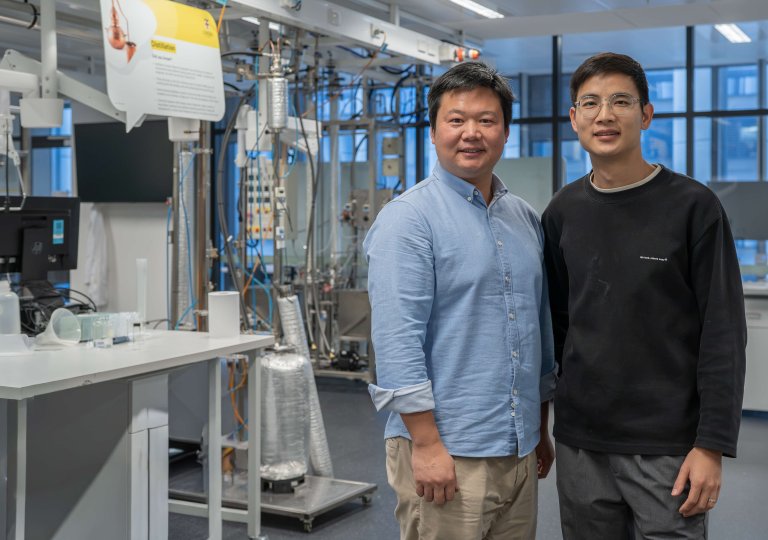
Supported by a TRaCE R&D Voucher, ZenQuo partnered with Associate Professor Dipan Kundu and his team in UNSW’s School of Chemical Engineering to tackle this problem from two directions.
The first was materials chemistry: reinforcing the NMFC particles against manganese loss, without sacrificing capacity in the process. The second was electrode engineering: finding a structure that improves conductivity without crowding out the active material.
Cracking the mystery of manganese loss
Over the course of the project, the team ran an extensive investigation into how and why NMFC degrades. The findings told a clear, if unexpected, story.
The project found that manganese loss is a fundamental trait of this cathode material, not just an engineering flaw that doping or additives could fix.
“Not hitting our performance targets doesn’t mean the project failed, it means we now understand exactly why this material behaves the way it does,” said Associate Professor Dipan Kundu. “That kind of clarity is what lets you stop guessing and start designing the next generation of materials with real precision.”
That understanding has since been published in Chemical Science, giving the wider battery research community a detailed picture of how these materials behave, and a clear direction for the next phase: designing interfaces and electrolytes that target manganese loss at the source.
Alongside the experimental work, the team also completed a technoeconomic assessment of AZIB manufacturing, modelling cell-level energy density, capital and operating costs, and recycling credits across different production scales and locations. This translational groundwork will help ZenQuo evaluate where and how a future AZIB product could be manufactured competitively.
“R&D projects like this are exactly where deep research value gets created, even when the destination isn’t the one you originally mapped out,” said Dr Priyank Kumar, Co-founder of ZenQuo. “We went in chasing a performance target and came out with a rigorous, published understanding of our material’s real limits, plus a costing model that sharpens where we focus next. That’s an outcome we can build on.”

Turning insight into the next breakthrough
For ZenQuo, the project has sharpened rather than closed off its path forward. With the degradation mechanism now understood, the team has shifted focus beyond the cathode material itself, to how the wider cell and system operate around it and exploring alternative cathode chemistries that could sidestep the manganese dissolution problem entirely as the technology moves toward larger-scale prototypes.
This project is a reminder that R&D doesn’t always go the way you expect, but clear, evidence-based answers still cut years of guesswork from the path to a viable product.
Expressions of interest for co-funding up to $50,000* through TRaCE R&D Voucher program are still open. If you are a small-to-medium enterprise, start-up or scale-up seeking easy access to co-designed and co-funded R&D projects in recycling and clean energy sectors, learn more and apply here.