
With growing global demand for clean energy and increased pressure on food systems, land use has become a critical issue. Solar farms and agriculture frequently compete for the same open space, even in a large country like Australia. Agricultural photovoltaics (agriPV), also known as agroPV, presents a promising approach: enabling farmland to simultaneously support crop cultivation and photovoltaic (PV) energy generation.
A new collaboration between Tindo Solar and researchers at UNSW is exploring novel luminescent materials to improve the performance, efficiency, and commercial viability of agriPV modules.
A Growing Energy-Food-Water Nexus
As the global push toward net zero accelerates, PV installations are rapidly expanding. At the same time, rising populations are demanding more food and fresh water, intensifying pressure on land resources. agriPV presents a powerful solution. Instead of choosing between crops or clean energy, agriPV systems are designed to do both by installing PV modules above agricultural fields in ways that complement plant growth and land productivity. These dual-use systems can:
- Provide shade and weather protection for crops
- Reduce evaporation and improve water efficiency
- Generate additional revenue streams for farmers
- Operate PV systems at lower, more efficient temperatures
Despite these benefits, current agriPV systems often use standard solar modules that are not optimised for the unique conditions of agricultural environments.
Central to this agriPV project is the development of advanced luminescent materials that maximise the use of sunlight, reimagining the PV module to function more effectively in agricultural environments. By integrating light-managing materials into the module structure, the system can optimise the solar spectrum for both photosynthesis and electricity generation.
Advancing Luminescent Solar Technology
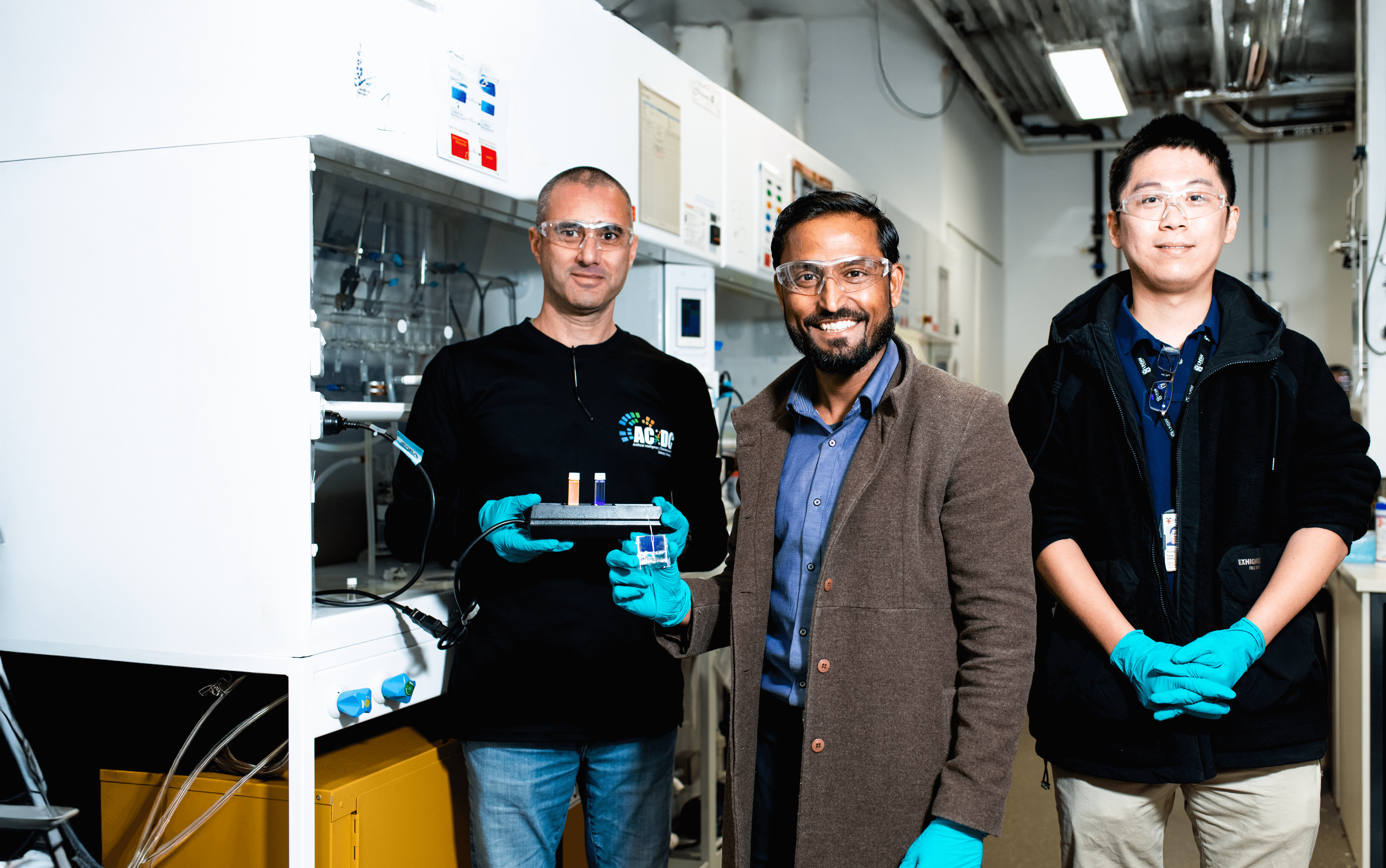
In collaboration with Tindo Solar, a research team led by Professor Ziv Hameiri and Dr Mahesh Suryawanshi from UNSW is developing advanced luminescent films through a $600k Lab to Market grant from the TRaCE Program. Designed for agriPV applications, these films allow the precise wavelengths of sunlight needed for photosynthesis to pass through, while capturing the rest of the spectrum and directing it to solar cells optimised for those frequencies.
The key innovation lies in the luminescent materials embedded within the films. These materials absorb light that plants do not use effectively and re-emit it at wavelengths better suited for electricity generation. This “smart filtering” transforms otherwise wasted sunlight into usable energy, enabling crops to thrive beneath the panels while increasing solar power output—a win for both agricultural productivity and renewable energy generation.

Powering Innovation Through Industry-Academic Partnership
This partnership brings together the deep scientific expertise at UNSW with the advanced manufacturing capabilities of Tindo Solar, Australia’s only solar manufacturer, to accelerate the development of next generation agriPV technologies.
UNSW researchers, led by Professor Ziv Hameiri and Dr. Mahesh Suryawanshi, bring extensive experience in PV materials, device physics, and solar cell reliability. Their advanced testing facilities, including environmental chambers and optical and electrical characterisation systems, enable precise evaluation of how emerging luminescent materials perform under real-world stresses.

“We are developing modules that generate energy while being seamlessly integrated into agricultural environments. Our goal is to bridge the gap between farming communities and the energy sector—both of which are critical to our future,” says Professor Hameiri. “By integrating luminescent materials with advanced light management capabilities, we can tailor the solar spectrum for both electricity generation and plant growth. It’s a truly exciting step forward in multifunctional PV technology. We’re aiming to deliver solar solutions that support agriculture, not displace it.”
“By working with Tindo Solar, we’re turning a research vision into a homegrown technology that benefits both the energy and agriculture sectors,” says Dr Mahesh Suryawanshi, Senior Lecturer and ARC DECRA Fellow at UNSW. “Most existing agriPV technologies prioritise energy production, but our approach puts farmers first, optimising conditions for crops while also generating clean electricity. The result is a solution that helps farmers produce more food, harvest more energy, and use their land more efficiently, a win for productivity, sustainability, and climate resilience.”
On the industry side, Tindo Solar is applying its end-to-end module design, fabrication, and testing capabilities to turn lab-scale innovation into scalable, commercial-ready agriPV systems. Their Adelaide-based factory enables close collaboration between engineers and researchers, allowing for rapid prototyping, field deployment, and performance validation in real conditions.
“Tindo has an in-house design and engineering function which allows us to work with external research teams on exciting solar PV innovations,” says Richard Petterson, CEO of Tindo Solar.
“By partnering with UNSW on the AgriPV panels, we’re not just developing new technology, we’re creating homegrown solutions that address the real challenges faced by Australian farmers and the clean energy sector. The ability to have agriculture and solar PV projects on the same land, is a real challenge but developing the solution is also an opportunity both for our domestic economy and for exports.”
Together, the partnership exemplifies how industry and academia can co-develop innovative solutions that bring high-impact solar technology to the forefront of Australia’s clean energy and agricultural future.