

In December 2025, nearly 30% of electricity across Australia’s National Electricity Market came from solar. As the shift away from fossil fuels accelerates and renewable electricity generation becomes more prominent, ensuring the long-term performance of photovoltaic assets has never been more critical.
But with scale comes complexity. Solar panels are built to last and designed to operate reliably for decades, but like any product, mass manufacturing under commercial cost pressures means defects are bound to emerge. When they occur, they can have a substantial impact on the performance and financial viability of solar assets.
Traditional inspection methods used to identify underperforming or defective modules across large facilities, whether via manual checks or ground-based systems, struggle to keep pace with the size and operational demands of modern farms, making them costly and often impractical at scale.
A TRaCE-supported R&D project with Lab360, a UNSW spinout company, is working to change that by advancing drone-based luminescence inspection methods and systems for utility-scale solar farms.
Seeing what conventional inspection methods can’t
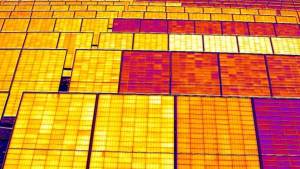
The project will advance drone-based inspection solutions that use highly sensitive imaging hardware to spot defects and hidden faults in solar modules from the sky.
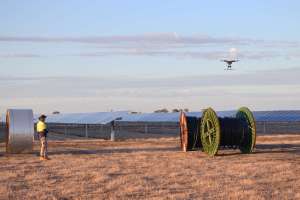
The technology, originally developed in UNSW, leverages luminescence imaging techniques, such as photoluminescence (PL) and electroluminescence (EL), to reveal microcracks, degradation and various other performance-limiting faults in the solar cells that are invisible to conventional inspection methods. Deployed on highly customised aerial drones, the system can rapidly survey large solar farms and improve inspection coverage, thereby reducing costs and operational disruption.
A central focus of the TRaCE supported project is the optimisation of imaging hardware and data acquisition protocols to consistently achieve high-quality imagery at speed and scale. This includes integrating state-of-the-art scientific cameras, advanced image analysis and augmentation techniques to improve image quality, and demonstrating robust, repeatable image acquisition routines.
The result will be practical, scalable inspection solutions designed to reduce energy losses and extend asset lifetimes, thereby lowering the cost of solar electricity.
Translating research into industry-ready solutions
The project is led by Lab 360 Solar (Lab360), a UNSW spinout company formed in 2024 by Professor Thorsten Trupke, Dr Oliver Kunz and Jürgen Weber from UNSW’s world-renowned School of Photovoltaic and Renewable Energy Engineering. The team is focused on translating advanced PV inspection technologies into commercially deployable tools for the solar industry.
Previously receiving financial support from the NSW Physical Sciences Fund, the NSW Clean Technology Innovation Fund and, ARENA, Lab 360’s innovation is being further accelerated through a $380,000 TRaCE Lab to Market grant.
Lab360 will use the project’s innovations to strengthen its growing suite of hardware platforms and control systems that are currently being developed.
“The luminescence-based inspection solutions we are now developing, including our unique drone-based daylight PL imaging technology, are a result of more than two decades of systematic research and development into luminescence imaging at UNSW,” said Lab360’s Chief Executive Officer, Professor Thorsten Trupke.
“ Our team pioneered luminescence imaging for photovoltaic applications at UNSW in the early 2000’s, initially with a focus on laboratory and factory applications. Even the idea of applying this measurement principle from aerial drones and in full daylight would have appeared unthinkable back then.
However, as our developments have shown, this technology can now provide important insights into the performance and quality variations in operational solar farms, and thereby significantly reduce the cost and complexity of solar farm diagnostics.
By spotting issues early and reducing the need for heavy equipment and associated labour, these innovations will support solar farm operators and owners in getting the most out of their solar panels and thereby support Australia’s clean energy future. ”
TRaCE partnerships bring more than funding. They provide access to UNSW’s world-class research facilities and expertise, alongside commercialisation support designed to move innovations beyond the prototype stage. Lab360’s project aims to help advance the technology from TRL 6 to TRL 8, positioning the company for early market entry and future growth.
“Drone-based luminescence inspection has the potential to become a cornerstone of modern solar asset management by allowing operators to move from reactive maintenance to more proactive, data-driven decision-making,” says Robert Gordon, Senior R&D Portfolio Manager at TRaCE.
“With continued development and commercialisation support, Lab360’s technology could set a new benchmark for high-volume solar inspection and support the long-term competitiveness of large-scale solar both domestically and around the world.”


