Australia’s climate technology sector could be worth $100 billion by 2035, if the ecosystem keeps up.
Australia’s climate technology sector already supports around 12,000 jobs, has attracted $8 billion in investment, and is estimated to have generated $11 billion in new economic value. By 2035, this could grow to 100,000 jobs, $60 billion in investment and $100 billion in economic value.*
This is not a niche or emerging concern, it is becoming a central part of Australia’s industrial and economic future. The real question is whether the ecosystem can create the conditions Australian companies need to scale, commercialise and compete globally.
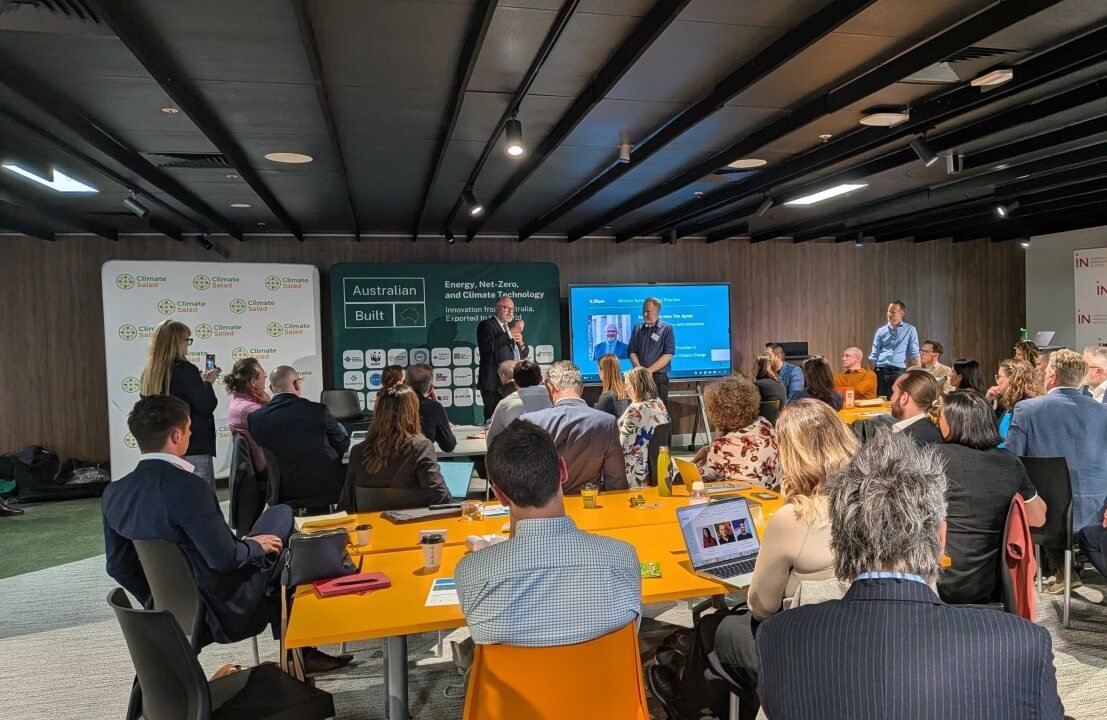
This was the focus of Australian Built 2026, held in Canberra on 16 September. Climate technology companies, investors, researchers, industry leaders and policymakers – including Senator the Hon Tim Ayres, Minister for Industry and Innovation, and the Hon Chris Bowen MP, Minister for Climate Change and Energy – came together not simply to showcase the sector, but to place it directly in front of the decision-makers who can accelerate investment, policy and commercial opportunities.
The case for action is straightforward: good policy accelerates good technology. The sector needs policy settings, regulation, tax structures and public funding mechanisms that reflect the realities of climate deep tech.
Why is scaling deep tech different?
Climate technologies are, for the most part, deep technologies: solutions that depend on scientific or engineering breakthroughs rather than software or business-model innovation alone. Unlike asset-light businesses, they need to develop and protect complex IP, build and test prototypes, access specialised infrastructure, navigate regulatory requirements, and raise significant capital for FOAK pilot plants, often well before generating meaningful revenue.
The result is a commercialisation journey exposed to greater technical, financial and execution risk. A technology can be investable in principle and still be years away from being customer-ready. The many gaps and valley’s of death between seed investment, first prototypes, first pilots and all the subsequent steps through to and a bankable, scalable product remains one of the sector’s biggest challenges.
TRaCE was established to help address some of these gaps and act as a very practical test bed to develop new models, incentives and programs that fast-track commercialisation.
Over the last three years, we’ve worked with more than 300 researchers and 170 companies, and learnt an enormous amount of very nuanced detail about what works, what doesn’t, exactly where commercialisation slows down, why and what support is consistently missing.
Our focus is now on turning those learnings into new ways of working and legacy programs that continue to build out the ecosystem,
including easier access for SMEs to technical expertise and engineering capability, seed funding, specialised infrastructure and equipment, and commercialisation support, among other elements.
Our experience shows that the greatest impact comes from coordinating these interventions: when the right resources are made available at the right stage, technologies progress faster, with less complexity and lower execution risk.
What the ecosystem needs next
There is more to do.
Support must be better coordinated across government, universities, investors, corporates and industry bodies, so businesses are not left navigating disconnected systems while trying to grow.
Australian Built 2026 created an important space for this conversation, including working groups and discussions focused on developing practical solutions and recommendations.
Whilst the intent and momentum are there, many of the speakers, including Minister Bowen and Ayres, talked about the speed required and better coordination across the ecosystem. and a This includes a sharp focus on aligning investment, policy and commercial settings with the realities of scaling deep tech, so more of these technologies can move from the laboratory through manufacturing and into widespread commercial deployment.
*Estimates based on 2025 reports from Cut Through Venture and Climate Salad