

Australian startup Siltrax has achieved a breakthrough in hydrogen fuel cell technology, with UNSW laboratory testing showing its silicon-based bipolar plates deliver twice the power output of conventional materials and resist corrosion 26 times better than stainless steel.
The results, produced through a TRaCE-funded collaboration with UNSW, position silicon as a serious alternative to the stainless steel and graphite plates that have long constrained fuel cell performance, and signal a significant step forward for clean hydrogen in hard-to-electrify sectors like heavy transport, shipping and aviation.
Supported by the Australian Government through the Trailblazer for Recycling and Clean Energy (TRaCE) Lab to Market Fund, the project paired Siltrax’s silicon manufacturing expertise with Dr. Quentin Meyer and Laureate Professor Chuan Zhao from the UNSW School of Chemistry’s NanoElectroChemistry Lab, connecting leading industry innovation with world-leading academics in green hydrogen generation to move new clean technologies toward market.

The collaboration delivered on its research objectives, generating the performance and durability data needed to assess the technology’s commercial potential, and demonstrating the value of industry–research partnerships in accelerating emerging clean energy innovations.
Hydrogen fuel cells are emerging as a promising clean-energy solution for sectors that are difficult to electrify. However, improving their performance and durability remains a key challenge. One critical component is the bipolar plate, a thin panel inside the fuel cell that conducts electricity and helps manage the flow of gases, water and heat. Conventional metal plates can corrode over time and often require costly protective coatings, while graphite plates are heavy and brittle.
To address these limitations, Siltrax, founded by UNSW alumni and entrepreneurs Dr. Zhengrong Shi and Dr. Jim Zhu, are building on their expertise in photovoltaics to develop ultra-thin silicon-based bipolar plates designed to improve both performance and longevity.
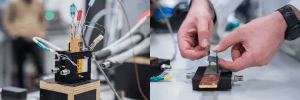
In laboratory testing against a conventional graphite plate, Siltrax’s silicon design delivered double the power output of traditional graphite plates. The gains were driven by the material’s inherent properties and a proprietary micro-channel design that optimises gas flow across the cell. On corrosion resistance, bare silicon plates corroded 26 times more slowly than stainless steel.
The heat transfer properties were also ten times superior to stainless steel, allowing the technology to dissipate heat more efficiently and maintain uniform operating temperatures. This property helps improve performance and extends system lifespan by reducing thermal stress.
“These results far surpassed what we anticipated. Silicon’s corrosion performance alone is a significant differentiator. Combined with the power output data, it is clear that ultra-thin silicon plates are a serious contender for next-generation fuel cells. Giving this technology the rigorous academic foundation it needs to move from the lab into the world is exactly the kind of work Australia should be investing in. I am proud to have been part of it,” explains Dr. Quentin Meyer.

For Siltrax, the project demonstrates the value of developing and validating new technologies within Australia’s research and innovation ecosystem.
“Siltrax was founded by former UNSW alumni, and this milestone shows what’s possible when world-class Australian research is translated into commercial technology,” said Fred Qi, Director of Sales Engineering at Siltrax.
“Australia has the expertise to help lead the emerging hydrogen economy, and our silicon bipolar plate technology is an important step toward bringing Australian-developed innovation to fuel cell manufacturers and hydrogen projects worldwide.”
“This project brings together the perfect combination of expertise, from Siltrax’s deep knowledge of silicon manufacturing and UNSW’s leadership in electrochemistry and hydrogen research. The TRaCE program has given both teams a powerful platform to validate what Siltrax has built, and we look forward to continuing that relationship and finding new ways to support Siltrax as they take this technology to market,” said Professor Chuan Zhao.
The next step is moving these lab results into commercial testing, with Siltrax setting its sights on hard-to-abate sectors that stand to benefit from their higher-performance fuel cells. With Australia as its base, the company is now pursuing opportunities across Asia-Pacific, Europe and the Americas.
Projects like this highlight the role of the TRaCE program in bringing researchers and industry together to validate promising clean energy technologies and supporting their path to market.