
TLDR:
- What will really enable FOAK Australian Climate technologies?
- Both public and private risk appetites need to meet closer to the middle.
- International partnerships are key to bridging gaps in Australia’s still-maturing capital markets, supply chains and market demand.
- Early-stage de-risking, through IP, commercial validation and R&D planning, is the most underleveraged lever in the stack.
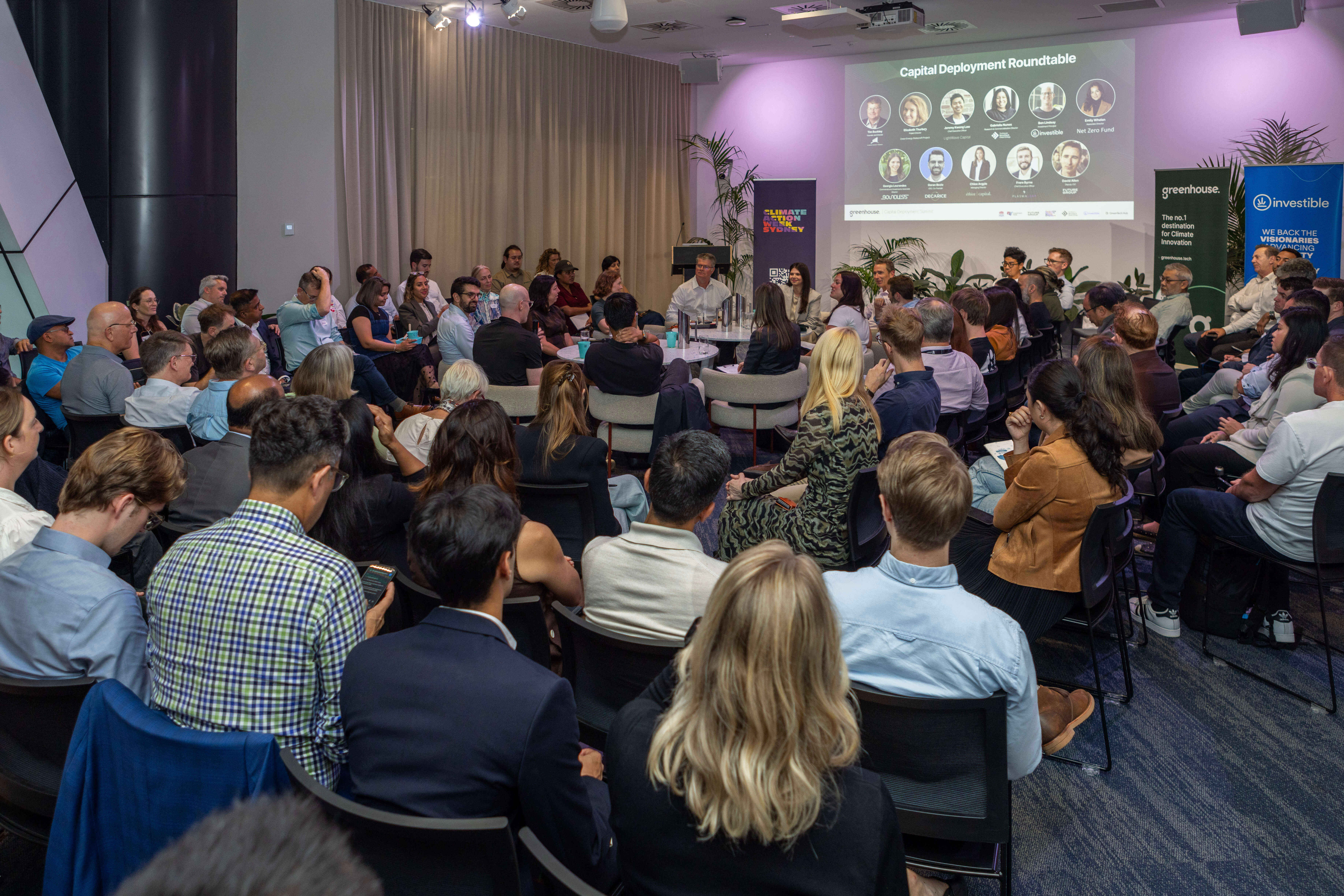
The discussions across Climate Action Week were as wide-ranging as the path from research to global markets and the capital stack that runs alongside it.
But let’s start at the beginning. The technologies needed to decarbonise the economy increasingly exist. The real challenge is financing the path from innovation to deployment.
In many cases, the underlying science and engineering are capable of delivering substantial emissions reductions – a large part of the challenge then lies in how risk is distributed across the capital stack.
First-of-a-kind (FOAK) technologies and projects are particularly exposed to this problem. At each stage—from early research and development, through venture investment, to infrastructure and project finance—different investors have fundamentally different risk tolerances. The result is a series of funding gaps where promising technologies stall before reaching commercial scale.
Across the ecosystem, there was a clear call for public institutions to take on greater early-stage risk. At the same time, many participants urged private capital—and mid-stage investors—to evolve their risk profile if Australia is to build globally competitive climate industries.
In practice, solving the problem likely requires both sides to meet somewhere in the middle, with risk shared more strategically across public and private actors – and derisking mechanisms, largely driven by government implementation on both sides.
In Australia, public institutions are starting to play a larger role in crowding in private capital across different parts of the stack. The CEFC provides concessional and catalytic finance for decarbonisation, the NRFC can deploy debt, equity and guarantees to back industrial capability in priority sectors, and NSW’s Energy Security Corporation is co-investing in large-scale storage and enabling infrastructure for the state’s electricity system.
But looking at the bigger picture, that premium can sit either on the supply side, through incentives for producers, or the demand side, through subsidies, procurement, or mandates that support early adoption.
Most successful international markets use a combination of both, alongside consistent policy frameworks that provide certainty for investors.
This dynamic is already visible in sectors such as sustainable aviation fuel (SAF). Many SAF producers are building export-oriented models because jurisdictions such as Singapore and the European Union have implemented policies or mandates that create guaranteed demand.
Australia still lacks an EU-style SAF mandate or similarly strong domestic demand signal, although federal policy support has strengthened materially through the Cleaner Fuels Program and ARENA’s low-carbon liquid fuels funding stream.
However, capital alignment alone is not sufficient. Another critical factor repeatedly raised was the need for strong international partnerships that create sustainable demand and enable cost reductions through scale, automation, and supply chain maturity.
At the same time, global geopolitical shifts are creating an increasingly urgent driver of climate investment: energy and fuel security.
Many countries introducing mandates or incentives for emerging energy technologies are doing so not only for emissions reduction, but to reduce dependence on volatile international markets.
Australia is uniquely positioned within this landscape. As a middle power and critical minerals superpower, Australia can play a strategic role in global decarbonisation supply chains— as a high-value R&D partner and by producing higher-value materials such as electrolytes or advanced battery components using Australia’s mineral resources.
Building these industries will likely require mutual investment partnerships with international markets where demand is already growing rapidly. Particularly across Asia, based on the scale of their energy demand and industrial growth.
Collaborative supply chains that link Australian resources and innovation with global markets could accelerate both cost reductions and technology deployment.
But to zoom all the way back out to the early stage, early offence is the best defence.
Practical solutions are required now.
TRACE has taken the view to proactively address risk much earlier in the innovation lifecycle, particularly around intellectual property, research translation, and early commercial validation.
De-risking as much as possible early on and developing R&D plans with active commercial and market input much earlier than traditionally sought, may go some way to minimising the bridges down the track or ideally by-passing them altogether.
How is TRaCE contributing to our ecosystem & addressing early-stage development Gaps?
One mechanism is TRaCE’s seed funding model, designed to bridge the early-stage investment gap. Under this approach, government-backed funding co-invests alongside venture capital into early ventures through a structured “call-back” mechanism. Venture investors are given the option to buy out TRaCE’s government-funded share within the first three years, returning the original capital plus a premium.
At the same time, the structure incentivises venture investors to participate earlier by reducing downside risk during the most uncertain stages of technology development.
This creates a revolving pool of public capital that can be recycled into new ventures, enabling support for a larger pipeline of early innovations over time and building out the ecosystem.
Variants of this model have been used successfully in ecosystems such as Israel in the 90s (Yozma) and Singapore’s Technology Incubation Scheme in the 2000s, where targeted public-private co-investment helped catalyse globally competitive technology sectors.
Australia has the opportunity to adapt this proven model to its own innovation ecosystem. It’s time to create Oz-Ma.
While TRACE is currently piloting this approach at the earliest stages of venture formation, the broader principle—strategic risk-sharing across public and private capital—could be applied across multiple points in the capital stack.
Another is the TRaCE Technology Translation Squad, which provides early, fast & free R&D support to SMEs, startups, and scale-ups developing climate technologies.
The program helps innovators start the journey of validating technical assumptions while also injecting engineering and industry expertise into the development process.
Promising technologies with strong potential to scale and deliver substantial emissions reductions can then progress through the innovation process. These are supported and monitored using a unique TRaCE developed Impact Model that projects emissions reduction, GDP contribution and jobs growth at each stage of development.
The TRaCE model provides deeper IP due diligence from the very beginning, technical development alongside commercial strategy and earlier ecosystem engagement, helping technologies move toward investable pathways more quickly.
Access to prototyping and testing facilities is also a critical practical piece all along the way. TRaCE has established access to this through the University of Newcastle’s Modern Manufacturing and Advanced Prototyping facilities and CSIRO’s newly launched Renewable Energy Integration Facility (REIF), built to test how solar PV, batteries and EVs perform under real-world grid conditions. This is particularly valuable for SMEs who don’t yet have the capital to acquire the infrastructure in-house but need the technical and engineering validation to progress.
Ultimately, the conversations at Climate Action Week reinforced a central point: climate innovation is not constrained by technology, but by how we validate, build, finance and scale it.
Bridging the gap between research breakthroughs and commercial deployment will require coordinated action across the ecosystem—aligning policy, capital, industry demand, and international partnerships.

Written by Gabriella Nunes, Research & Commercialisation Director at TRaCE.