TL:DR
- Integration rather than silos – across international markets, government, industry, academia and private capital – is the critical path to implementing sustainable technologies & solutions.
- Consistent government policy is critical for a faster transition to Net Zero.
- Opportunities to expand into new markets are on our doorstep across ASEAN, and we’re excited to see them unfold.
Author: Gabriella Nunes, Research and Commercialisation Director, Trailblazer for Recycling and Clean Energy.
For a big island, Australia punches above its weight in renewables research and deep tech. We invented the solar cell and vanadium flow battery but haven’t fully capitalised on either as a nation (yet).
For a small island, Singapore punches above its weight for consistent Government policy and strategy. Because of this, they have had successes such as transitioning to recycled water, which currently forms 40% of Singapore’s total water demand.
Both Australia and Singapore have a lot to learn from each other. Both nations combined could represent a large part of the regional value and supply chains from R&D to global manufacturing and distribution.
What have Singapore got right?
Singapore has been successful in integrating climate technologies based on three key factors:
- FUNDING is strong in both government and private sectors.
- Singapore will invest S$25 billion – or 1 per cent of its GDP – in research, innovation and enterprise for the next five years in key areas of focus that include health, sustainability, digital economy, and manufacturing. Comparatively, expenditure on R&D performed by Australian government organisations in 2022-23 was $4,344 million – 0.17% of GDP.
- The Public-Private Partnerships (PPP) market is strong, allowing agility in the financing, development, and operation of service-based infrastructure. The Singaporean Government also provides grants and tax incentives to encourage industry collaboration with research institutions, as well as backing global investment firms such as Temasek to crowd in private capital into the climate tech space.
- Private capital is also abundant, with a strong HNWI and family office network. There are now 1,110 family offices in Singapore.
- CONSISTENCY — 60+ years of consistent Government policies, funding, and strategies have been critical for long-term change and a quicker transition to implementing solutions driving toward net zero. An example is the Singapore Green Plan 2030, which is a joint effort by five government ministries to chart Singapore’s way towards a more sustainable future over the next decade. The wide-randing plan cuts across all sectors of society, ranging from infrastructural development, research and innovation, training programmes, and supportive grants and schemes to finance the planned initiatives.
- URGENCY is a key driver alongside strong and consistent policy.
-
- Based on water scarcity and security threats, Singapore has transitioned to producing water by recycling wastewater since the 1970s and is currently supplying 40% of Singapore’s total water demand with recycled water.
- Similarly, the landfill will run out of space by 2035 at current waste disposal rates. This accelerated Singapore’s development of four Waste-To-Energy plants, where they seek to reduce the volume of waste by up to 90% while generating electricity that is sold to the grid. The newest and largest of the Waste-To-Energy plant, Tuas South Incineration Plant (TSIP), which opened in July 2022, can incinerate 3,000 tonnes of waste daily and generate approximately 1,600 megawatts of electricity per day where 20% of that powers the plant with remaining exported to daily pushed back into the grid. It is not a perfect model given the emissions of incineration however, the foundations of the system in which new technologies can be integrated have been laid.
What can Australia learn from this?
Singapore’s consistency in policy and direction is in stark contrast to Australian policies and funding of recent years. Core programs are stood up and torn down with each election cycle, putting the maturity of our ecosystem back decades and severely impacting investor and partner confidence.
From a funding perspective, a blended capital stack is required across each stage of scale or valley of death, something still maturing in Australia.
In the early stages, non-dilutive or founder-friendly seed funding is increasingly available. Yet funding from $10M plus / Series B is difficult to secure which can be detrimental for climate-tech companies that tend to be asset-heavy compared to software technologies.
For capital-intensive First-Of-A-Kind (FOAK) technologies, particularly hardware, where each stage of scaling calls for significant capital to build pilot facilities or next-stage manufacturing, there are only a handful of local VC investors with the fund size and risk appetite to write the cheques required at this stage.
The “missing middle” is another casualty. Firms too advanced to interest venture capitalists, but too small and unproven to attract infrastructure investors who write the really big cheques.
Attracting international partners into this mix becomes an option, but it is difficult to get the attention of given policy inconsistencies coupled with the market size in Australia in comparison to opportunities offshore.
The industries that should be thriving at this stage of the energy transition — batteries, green hydrogen, green steel — are square pegs that don’t fit in the round hole of capital markets.
An alternative is for Aussie companies to look more outwardly towards international investors, larger corporations and MNCs to access and integrate into their networks, distribution, value or supply chains.
This is a big focus within Singapore, with many startups turning to large Corporate Venture Capital that could be in a better position to access and deploy their new technologies while providing financing– which is an approach that is less familiar to Aussie corporates or government agencies due to differences in risk profiles.
What has Australia got (or is getting right)?
Our ecosystem of support for new technologies, particularly climate technologies, is maturing. More and more startup and research commercialisation programs, specialist funds and funding bodies are being established.
The 22.7B Future Made in Australia policy is a huge step forward but consistency and commitment of those funds over the next decade will be the true test.
The Trailblazer programs, Australia’s Economic Accelerator and the National Reconstruction Fund are also pointing us all in the right direction.
We need strong, consistent, policy that integrates government, research and industry, and takes a whole of ecosystem approach to develop technologies and push them to market, while ensuring we have the manufacturing capabilities, skills and jobs to integrate them.
If we get this holistic policy right in the long term, we’ll be cheering alongside Singapore, yet we must maintain a strong global focus.
Many Aussie companies look first and foremost to the United States – English-speaking and significant market size, but fiercely competitive. Singapore, right on our doorstep, is an English-speaking, capital-rich country with a fast-paced market, littered with the regional headquarters of numerous multinationals – all with pressure to meet Environmental, Social and Governance (ESG) targets. They are actively seeking technologies to pilot in Singapore and then scale out via their significantly large distribution networks across ASEAN and Northeast Asia.
Singapore has an enormous focus on Waste to X energy or products. Recycling, circular economy and water management are core climate tech focus and opportunity areas.
With port and aviation hubs ranking amongst the busiest in the world, emissions reduction through maritime, shipping and aviation also offers significant potential. The Singaporean Government has recently introduced a policy that aims to drive a 20% reduction in domestic aviation emissions from 2019 through increased use of Sustainable Aviation Fuels (SAF). By introducing a SAF levy, they hope for all flights departing from Singapore to use beyond 1% SAF in 2026 to 3 – 5% by 2030.
How do we partner?
Australia’s advanced R&D in renewables, complex recycling and circular materials production and growing quality of deep tech climate startups are all ripe for collaboration in the region.
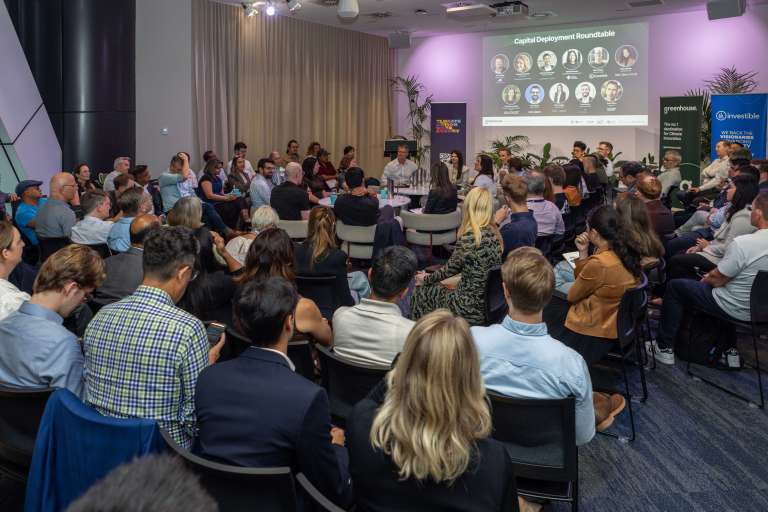
A recent delegation run by Investment NSW to the CleanEnviro Summit in Singapore is a great example of leading Aussie startups and scaleups directly accessing rooms full of qualified investors, customers and partners.
“We had the privilege of hosting the UNSW Trailblazer team and 15 NSW startups in Singapore at June’s CleanEnviro Summit APAC. The objective was to showcase the finest of Australian climate tech capabilities. The engagements in the market were amazing in bringing together diverse ideas and fostering innovation partnerships. It was really encouraging to see how initial knowledge exchanges amongst companies between the two nations have flourished into real commercialisation and distribution opportunities.” Ms Cassy Xie, Director of Trade & Investment Singapore, Investment NSW
Collaborative R&D between Australia’s leading researchers, industry and international partners right from the early stages is another promising yet undercapitalised way to ensure the tech is designed to be market-fit and commercially viable.
For more opportunities in any of these areas, get in touch with the team at TRaCE.