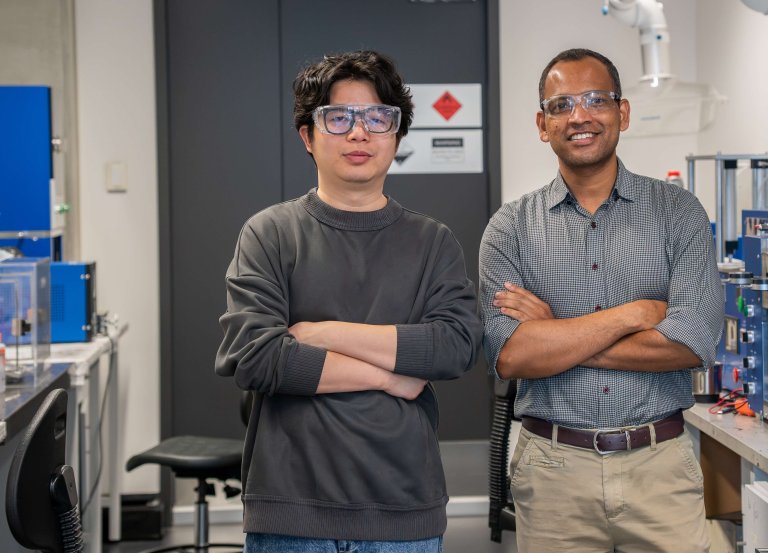

A new TRaCE Mobility Fellowship is helping accelerate the development of next-generation thermal energy storage technologies, while further strengthening the growing partnership between the University of Newcastle and clean energy innovator FPR Energy.
This is the second TRaCE Mobility Fellowship delivered with FPR Energy, reflecting the success of the ongoing relationship and shared commitment to translating research into real-world clean energy solutions. It also follows the recent extension of an existing TRaCE R&D Voucher project with the company, demonstrating continued confidence in the collaboration and its potential to deliver industry impact.
Through a 12-month secondment, University of Newcastle researcher Matt Patterson will join FPR Energy to support the development and optimisation of the company’s electrical Thermal Energy Storage (eTES) platform. The project focuses on improving how thermal energy is transferred to ceramic particles to be stored; a critical challenge in developing efficient, high-temperature energy storage systems capable of supporting renewable energy integration and industrial decarbonisation.
Working with FPR Energy, Matt will contribute to the design, commissioning and testing of experimental particle-heating technologies. The work will investigate different approaches to heating the ceramic particles while evaluating factors such as energy transfer efficiency, particle flow behaviour and heat loss under varying operating conditions.
By combining industry expertise with university research capability, the fellowship aims to identify opportunities to refine system design, improve performance and support future scale-up. The knowledge generated through the project could also have the potential to contribute to the commercial readiness of FPR Energy’s eTES technology, helping to expand the application of thermal energy storage solutions across renewable energy and energy-intensive industries.
Matt’s fellowship builds on a growing portfolio of collaborative projects between TRaCE and FPR Energy, demonstrating how TRaCE’s programs can support companies at multiple stages of technology development.
By embedding researchers within industry environments, TRaCE Mobility Fellowships create opportunities for knowledge exchange, assist in technology development and strengthen pathways to commercialisation. For FPR Energy, the fellowship provides access to specialised research expertise that will help tackle technical challenges and support the next phase of growth for its energy storage platform.
It also highlights the unique value researchers can bring to industry-led innovation projects. Researchers are trained to operate in emerging environments where challenges are complex, outcomes are uncertain and solutions are not always immediately apparent.
Their ability to navigate complexity, apply critical thinking and develop evidence-based solutions makes them well suited to tackling the kinds of challenges often encountered in emerging technology development. This combination brings valuable innovation capability to industry partners working to accelerate technology development and commercialisation.
As Australia continues its transition to a low-carbon economy, collaborations like this play an important role in developing the technologies needed to support cleaner, more resilient energy systems. Through ongoing investment in industry-research partnerships, TRaCE is helping companies like FPR Energy bring innovative solutions closer to commercial deployment while creating lasting economic and environmental benefits.