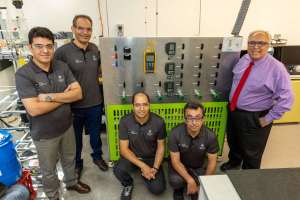

Laureate Professor Behdad Moghtaderi and the AMMONIAC team have successfully completed the first stage in scaling up their green ammonia production technology.
Ammonia is a highly sought after global commodity primarily used in fertilisers for the agricultural industry. Demand is only expected to grow, with the Stated Policies Scenario projecting ammonia production to increase 40% by 2050.
However, current production processes are energy and carbon intensive. Ammonia production accounts for around 2% of the world’s annual energy consumption and leads to direct carbon emissions of over 450 million metric tonnes a year.
Laureate Professor Moghtaderi and his team of researchers at the Centre for Innovative Energy Technologies (CINET) embarked on a Trailblazer for Recycling and Clean Energy (TRaCE) Major Project in 2023 with AMMONIAC to develop a simpler, more cost effective and sustainable process.
AMMONIAC is a technology platform designed to convert hydrogen and nitrogen into high purity ammonia using 100% intermittent renewable energy. It essentially ‘breathes in’ nitrogen and hydrogen and ‘breathes out’ ammonia by cycling between different reaction environments at near ambient pressure.
Phil Matthews, AMMONIAC Founder and Managing Director, says the AMMONIAC process could lead to a ‘paradigm shift’ in ammonia production.
“To my knowledge, this process has never been done before. The ammonia can be used for fertiliser, fuel and electrons or heat for industrial applications, which may cut emissions in multiple sectors,” said Mr Matthews.
Scaling up in stages
Following lab-scale testing with various catalytic materials and refining the process, the team has finished building and testing a 100 g/day proof-of-concept prototype.
Laureate Professor Moghtaderi said early results on the unit’s efficiency have exceeded his expectations.
“These results are extremely promising and in terms of performance characteristics the unit meets all our design specifications. If these results are translated into large-scale production, we would be able to produce green ammonia at a levelized cost of about US$200 per tonne of ammonia,” said Laureate Professor Moghtaderi.
“This is around a quarter of the levelized cost of other green ammonia production technologies and very comparable with the price of fossil-fuel based ammonia in the global market today.”
The results of the prototype mark a significant step in scaling up the technology to full commercial operation, with the next stages involving the design and commissioning of a 100 kg/day pilot-plant and 10 tonne/day reference plant.
“The potential of this technology is huge. I could give the AMMONIAC unit to a farmer and with air and water from the ground, they could produce ammonia. They can then use that ammonia for fertilisers or crack it down into green hydrogen for clean energy, and the best part is that the by-product is pure water,” said Mr Matthews.
With their sights now set on designing and commissioning the 100 kg/day pilot plant, the 100 g/day unit will be a valuable resource for the team to further refine the process and trial potential improvements in the future.