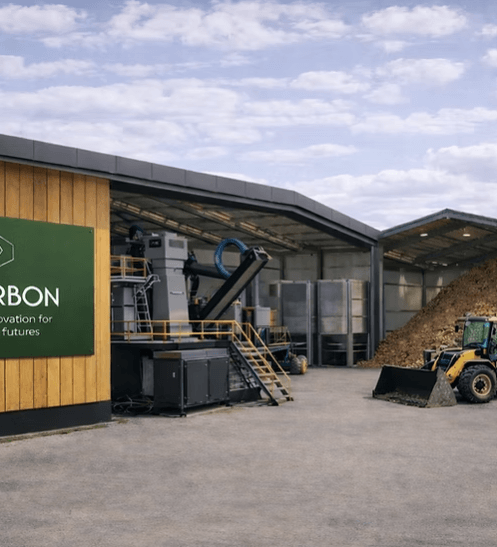
TRaCE partner, BioCarbon, has recently secured $4.8 million in ARENA funding to establish a commercial scale biochar production facility in Bulahdelah, NSW. With a total project value of $10.9 million, this initiative marks a major step toward decarbonising Australia’s steel industry.
The new facility will scale up BioCarbon’s innovative pyrolysis and biochar consolidation technologies, converting 20,000 tonnes of waste woodchips per year into around 8,000 tonnes of renewable carbon products. BioCarbon “GreenChar®” pellets are designed to replace fossil-based carbon products in Electric Arc Furnace (EAF) steelmaking.
The emissions from the carbon used in the EAF at InfraBuild’s Rooty Hill, NSW, facility, are the second largest contributor to its Scope 1 emissions. The project aims to replace at least 90% of the facility’s EAF charge carbon requirements with renewable carbon alternatives, that match fossil-based coke in performance and cost.
The commercial demonstration plant at Bulahdelah will validate BioCarbon’s technologies at scale, proving the effectiveness of high carbon biochar (with 95% fixed carbon), and the production of durable biochar products, suited for continuous EAF operation. The outcomes of the Bulahdelah project, are expected to support future expansion, including potential for a similar facility to supply the EAF at InfraBuild, Laverton.
Beyond its primary product, the facility will generate two valuable co‑products: wood vinegar, which has emerging uses in agriculture, and clean burning syngas, which will be used as a source of renewable energy for industrial heat and/or electricity generation. This integrated approach supports circular economy principles by ensuring efficient use of all outputs from the pyrolysis process.
The project is supported by a strong consortium of partners, reflecting a shared commitment to low emissions industrial transformation. For TRaCE, BioCarbon’s work continues to support research collaboration and provide meaningful opportunities for University of Newcastle Work Integrated Learning (WIL) students and PhD candidates to contribute to the development of clean technology solutions with national impact.