The demand for solar is reaching new heights with projections that solar photovoltaic (PV) generation will account for 80% of the growth in global renewable capacity between now and 2030.
However, PV manufacturers are faced with a serious bottleneck. To conduct quality control testing, traditional current-voltage (I-V) testers must physically touch the fragile cell surface that can be damaged by contact. They also struggle with current structures such as multi-busbars, zero-busbars, and back contacts, as well as next-generation technologies like perovskite and tandem solar cells. Moreover, traditional methods limit testing to late stages of production (post-metallisation), missing early-stage defects and slowing production to around 7,000 cells per hour. This inefficiency results in enormous material waste and delayed defect detection, contributing to an estimated USD 1.4 billion annual cost to the global PV industry.
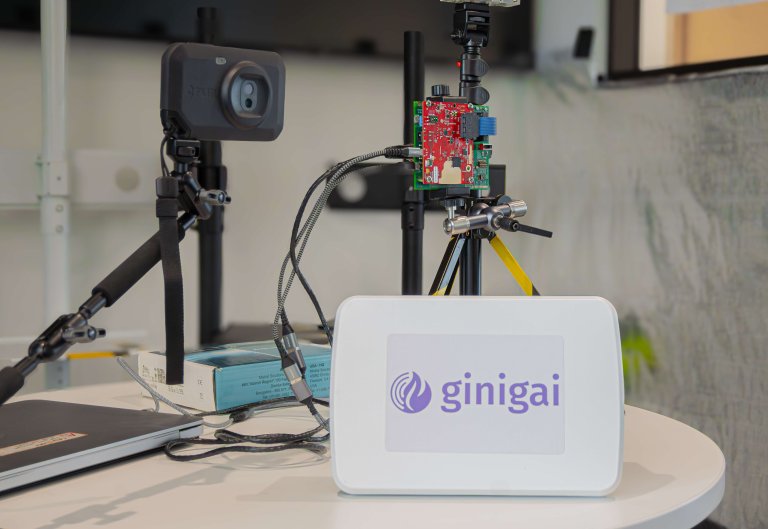
Researchers at UNSW’s ACDC Research Group are partnering with BT Imaging in a project to develop a game-changing solution: a contactless, ultra-fast line-scan photoluminescence (PL) system that is building a faster, gentler, and smarter way to test solar cells, increasing throughput, reducing waste, saving billions, and preparing for the solar technologies of the future.

A Contactless Solar Testing Solution
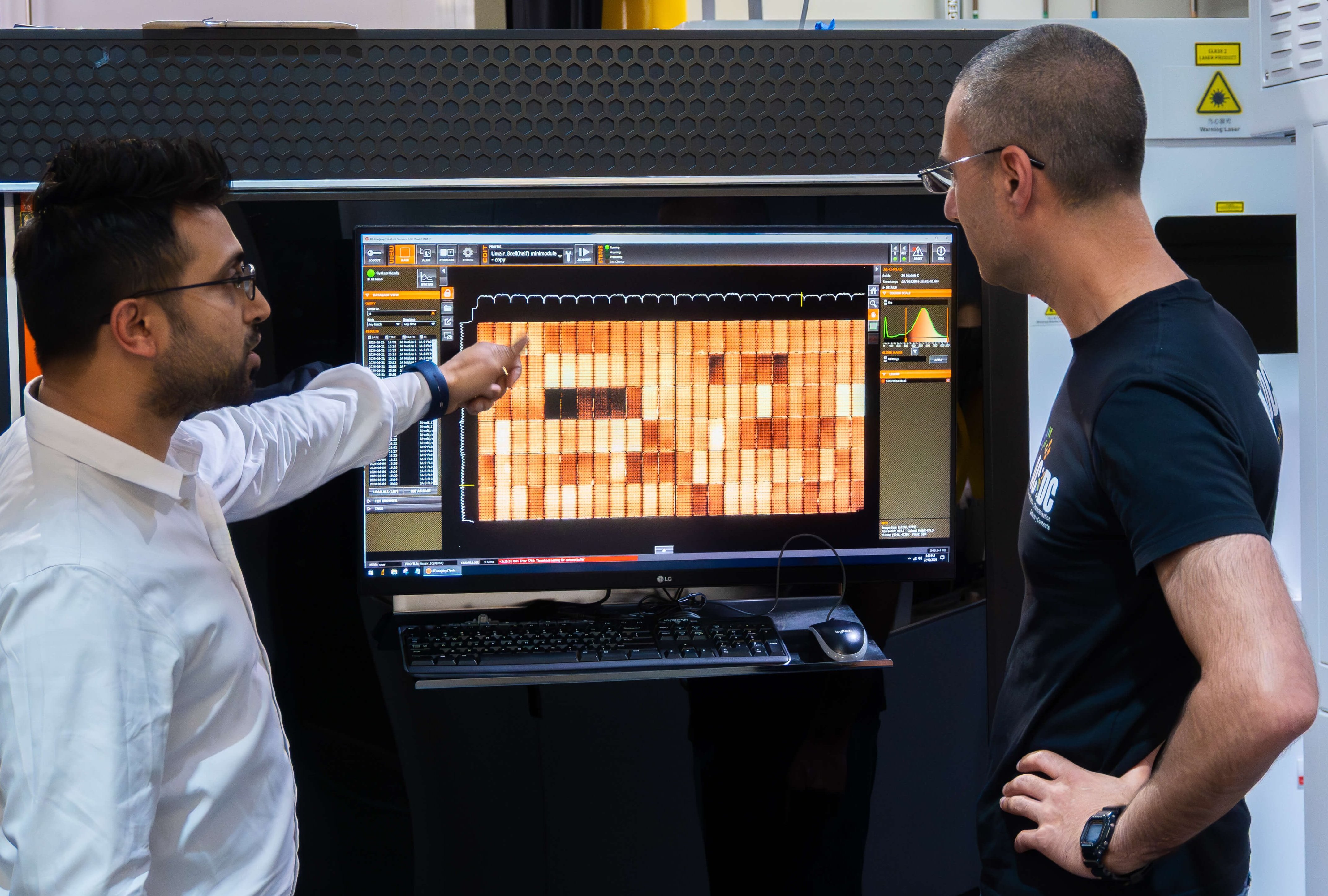
This collaboration is pioneering contactless, line-scan measurements. Instead of physically probing the surface, which risks damaging the fragile cells, the system works by shining light onto a solar cell and analysing the faint glow it emits. This glow or ‘luminescence’ reveals key electrical properties such as voltage, series resistance, and efficiency. With advanced imaging and machine learning, the data can be converted into detailed maps of defects, performance, and even predicted lifespan.
This approach offers several critical advantages:
- No contact, no damage – cells remain intact during testing.
- Earlier detection of defects – testing can be done in early stages (pre-metallisation), saving time and reducing waste.
- Much faster throughput – doubling the number of cells inspected per hour.
- Future-proofing for next-generation technologies – the system works not only with today’s silicon cells but also with emerging perovskite, multijunction and tandem solar cells, that are widely regarded as the future of solar technology. However, their complex structures demand equally advanced inspection techniques. The contactless PL system directly addresses this gap, making it a versatile, scalable solution that could help bring next-generation solar cells into mass production.
From lab to market: A partnership to transform solar manufacturing
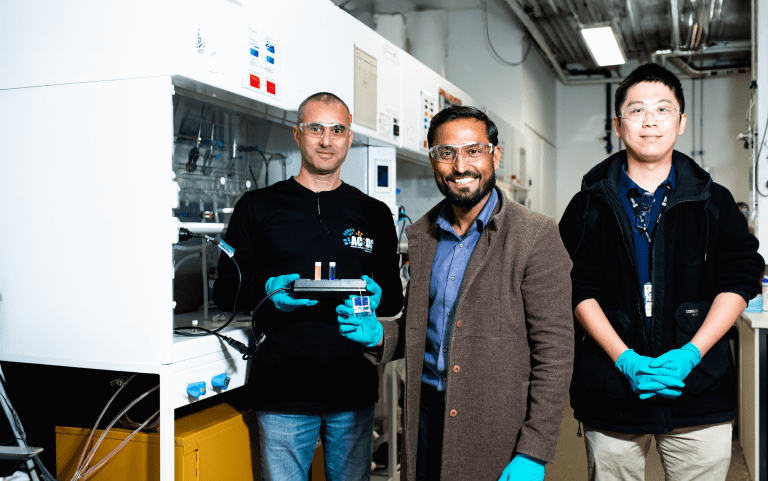
At the core of the project is a strong research–industry collaboration, building on earlier research from UNSW’s ACDC Research Group. The project is led by Professor Ziv Hameiri from UNSW, whose team has pioneered new inspection methods for high-efficiency solar cells.
On the industry side, BT Imaging, a spin-out from UNSW’s School of Photovoltaic and Renewable Energy Engineering, brings 20 years of experience developing and commercialising innovative testing solutions for the global solar industry. Backed by the TRaCE Lab to Market Fund with a $400,000 grant, this partnership is working to turn UNSW’s laboratory breakthroughs into practical, factory-ready systems for both silicon and next-generation solar cells.
“Our goal is to address an urgent industry need. While solar cells have advanced dramatically in recent years, with more sophisticated structures and outstanding performance, the main inspection tool, the current-voltage tester, has remained largely unchanged for over a decade. These testers are no longer suitable for measuring modern solar cells and face even greater limitations with emerging technologies,” says Professor Ziv Hameiri. “Through this collaboration, we aim to reshape the industry by introducing contactless measurements that overcome the limitations of standard current-voltage testers, while offering lower cost, higher throughput, and, most importantly, new insights that will make solar cells more efficient and reliable.”
“As a UNSW spin-off, BT Imaging is built on the strength of academic research, and partnerships like this allow us to keep pushing innovation into the marketplace,” adds Dr. Shubham Duttagupta, Managing Director of BT Imaging. “By combining UNSW’s cutting-edge methods with our commercialisation expertise, we’re creating inspection systems that manufacturers can rely on, faster, more accurate, and future-proofed for the next generation of solar cells.”
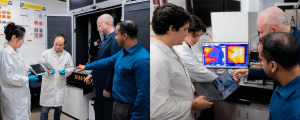
Looking ahead, the contactless inspection method aims to become the new standard across silicon and tandem solar cell production lines, ensuring consistency and reliability at scale. As machine learning capabilities are integrated, from automated defect classification to lifespan prediction, the system will grow even smarter, providing manufacturers with deeper insights and greater confidence in every cell produced.
This project will not only revolutionise solar manufacturing but also positions Australia at the forefront of solar manufacturing innovation, bringing the world closer to a cleaner and more efficient energy future.