
In a $4.2 million R&D project, researchers at UNSW Sydney have developed a next-generation electrolyser system when coupled with a Fischer-Tropsch reactor, can convert carbon dioxide and water into Sustainable Aviation Fuel (SAF), using renewable electricity, a critical breakthrough for cutting emissions in aviation.
Decarbonising aviation is one of the toughest challenges in the race to net zero. Unlike cars or homes, planes can’t easily switch to be electrified and the fuels they burn release large amounts of carbon dioxide into the atmosphere. Globally, aviation accounts for about 2–3% of emissions, but it’s a fast-growing sector with limited alternatives.
Many emerging clean energy technologies aim to replace fossil fuel production with sustainable aviation fuels (SAFs) and e-fuels but these solutions are still expensive, energy-intensive, and not yet ready for mass deployment.
In response to this challenge, UNSW researchers are developing a new generation of electrolyser systems that, when integrated with a Fischer-Tropsch (FT) reactor, can convert carbon dioxide and water into clean fuels for the aviation sector.
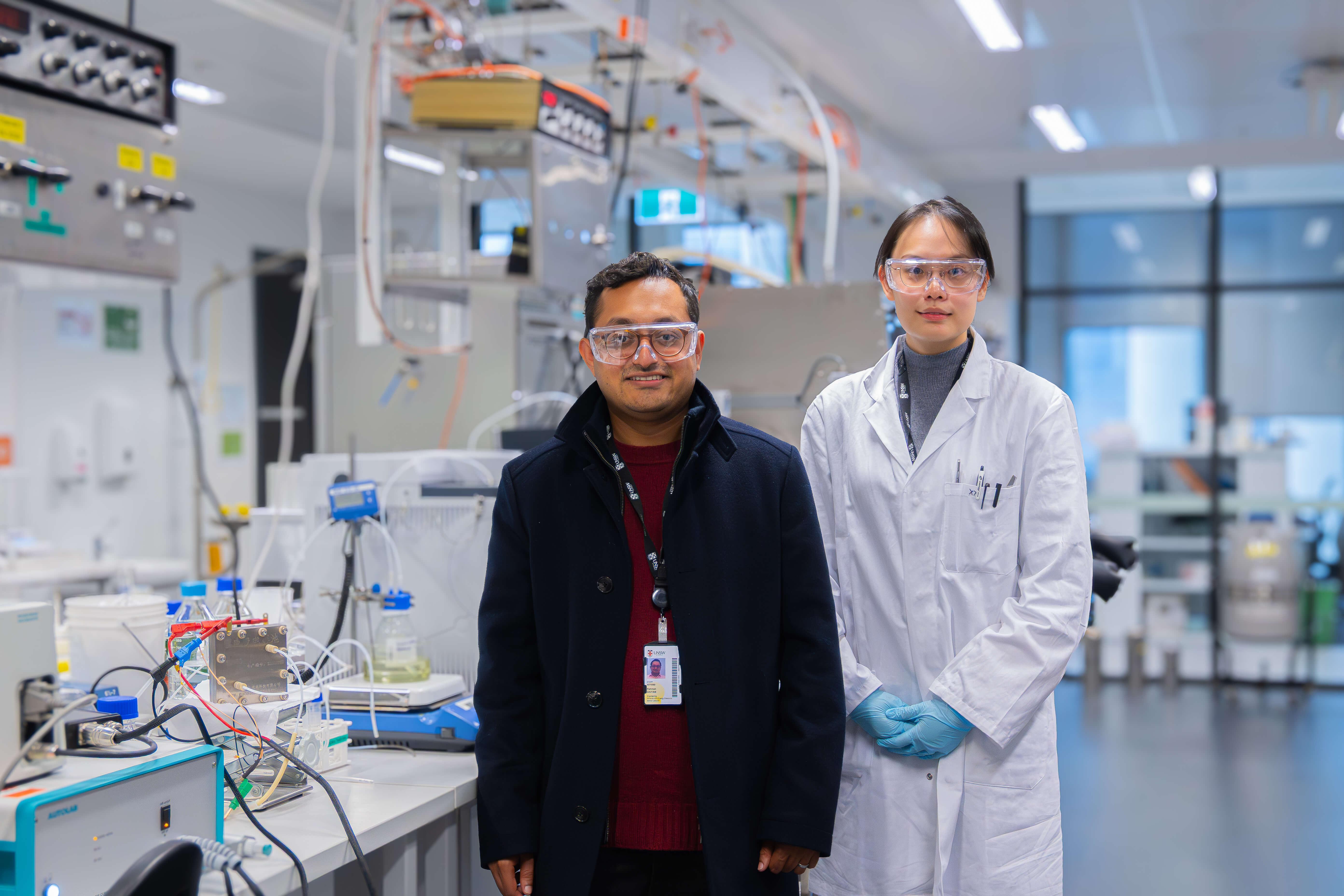
Supported by the Trailblazer for Recycling and Clean Energy (TRaCE), the project is a collaboration with Australian partner Tjindu Power and Chuangqi Times (Qingdao) Technology Company, a clean tech developer based in China, which is working to bring the technology to market in Australia. The project is led by UNSW researchers Dr Rahman Daiyan, Scientia Professor Rose Amal, and Professor Jimmy Yun.
Advanced Carbon Dioxide Electrolyser System
The UNSW-led project is scaling up a carbon dioxide electrolyser system developed by the team using low-cost transition metal and carbon catalysts, which will be integrated with the Fischer-Tropsch process to produce SAF. In essence, this technology enables the direct transformation of CO₂ and renewable electricity into fuels that work in existing engines and infrastructure (drop-in fuels), supporting the decarbonisation of hard-to-abate sectors without requiring major infrastructure changes.
“Our goal is to revolutionise how we produce clean fuels for aviation, using renewable energy to transform CO₂ into usable fuels without requiring costly infrastructure changes. This technology could be the key to decarbonising aviation, one of the world’s most challenging sectors,” said Dr. Rahman Daiyan, Lead Chief Investigator at UNSW Sydney.
“This breakthrough proves that with smart catalyst design and integrated system thinking, we can transform waste CO₂ into the very fuels that drive our economy. It’s the kind of scalable innovation we need to tackle hard-to-abate sectors and achieve net zero,” said Scientia Professor Rose Amal.

Accelerating from Lab to Market
The project received a $1.2 million grant from the TRaCE Lab to Market Fund, to move the technology from TRL 4 (proof-of-concept in the lab) to TRL 6 (validated prototype in a relevant environment). A spin-out company, Gurung Fuel, led by the industry partners has been created to lead commercialisation, stakeholder engagement, and capital raising.
“This partnership is a major step towards scaling the cutting-edge electrolyser technology. We’re not just developing a solution, we are creating a game-changer for the aviation industry, with the potential to make a global impact,” said Professor Jimmy Yun from Chuangqi Times (Qingdao).
A strategic opportunity for Australia
Australia is facing a critical challenge in its fuel security. Currently, the nation holds only 48 days’ worth of fuel reserves – far below the 90 days required by international standards. The nation’s heavy reliance on imported fuel makes it vulnerable to global disruptions and recent geopolitical crises have underscored the urgent need for a sustainable and self-sufficient solution.
UNSW’s groundbreaking technology offers a promising path forward. By producing clean, renewable fuels, Australia could reduce its dependence on fossil fuels, and enhance its energy security. And with the rising global demand for Sustainable Aviation Fuel (SAF), Australia has a unique opportunity to emerge as a leader in renewable fuel production, while contributing to the global effort to decarbonise aviation. With the right support, Australia could not only secure its fuel future but also help power the global transition to net-zero.


