How a partnership between the University of Newcastle and EVOCRA is advancing PFAS remediation
One of the most pressing environmental and health challenges of our time lies hidden in the bloodstreams of nearly all Australians. The 2022-24 National Health Measures Survey, reported by the Australian Bureau of Statistics in 2025, revealed that up to 98 per cent of Australians aged 12 years and over have detectable levels of per- and poly-fluoroalkyl substances (commonly known as PFAS) – potentially harmful, man-made chemicals that have infiltrated our bodies.
Known as “forever chemicals” (so named because they persist indefinitely in the environment and human body), PFAS represent a group of over 4,000 chemicals that have been widely used since the 1950s to manufacture products that resist heat and repel water, grease and stains. Their exceptional chemical stability – ironically one of the reasons they were originally used – has now become their greatest liability.
A groundbreaking partnership between the University of Newcastle and Australian company EVOCRA is tackling the destruction of these chemicals head-on.
Collaborating with Chief Investigators Laureate Professor Behdad Moghtaderi and Dr James Dickinson from the Centre for Innovative Energy Technologies and supported by the TRaCE R&D Voucher program, EVOCRA is piloting a breakthrough “PFAS Harvester” technology that not only destroys PFAS contaminants but also recovers valuable resources in the process.
“One of the challenges facing the remediation of contaminated PFAS sites is management of the shared responsibility in addressing the problem,” explained Professor Moghtaderi.
“This extends from producers down to utility managers and comes with a cost to clean up. Through our collaboration with EVOCRA, we aim to deliver a technology that not only destroys PFAS but also provides means to offset the energy cost of destruction by transforming the contaminated waste into saleable by-products.”

The PFAS Harvester: A comprehensive solution
Due to its widespread use, PFAS contamination is today recognised as a growing environmental problem, with research suggesting that exposure to PFAS is associated with adverse health outcomes.
Industry has responded by developing remediation technologies that exploit physiochemical properties to remove, concentrate, and to a lesser extent, destroy PFAS and PFAS contaminants. These technologies are generally characterised as either primary or secondary treatment processes.
- Primary treatment processes focus on separating and concentrating PFAS from waste and water streams, including numerous remediation sites found across Australia at airports, defence sites and fire-fighting facilities.
- Secondary treatment processes focus on the destruction or breakdown of PFAS, which is commonly achieved through thermal treatment, such as incineration which requires a high energy footprint. Incineration is offered at limited sites across Australia, often requiring large volumes of PFAS to be transported over significant distances before it can be processed.
Recognising the need for a more comprehensive solution, EVOCRA, together with the University of Newcastle, is developing an innovative secondary treatment technology that will complement existing primary treatment approaches and create an end-to-end PFAS remediation solution, with zero PFAS discharge.
This project builds on the foundational work done between the University of Newcastle and EVOCRA. In 2019, this partnership was awarded $820,000 through the ARC’s Special Research Initiatives scheme for PFAS remediation to investigate a secondary treatment technology for PFAS destruction. This led to the refinement of EVOCRA’s proprietary OzoFractionation® process for PFAS extraction at the Newcastle Institute for Energy and Resources (NIER).
“Combining the PFAS Harvester with EVOCRA’s OzoFractionation® process provides an opportunity to extract and eliminate PFAS from the environment at the remediation site. This approach reduces the carbon footprint and risky transport to hazardous waste facilities.”
– David Solomon, EVOCRA CEO
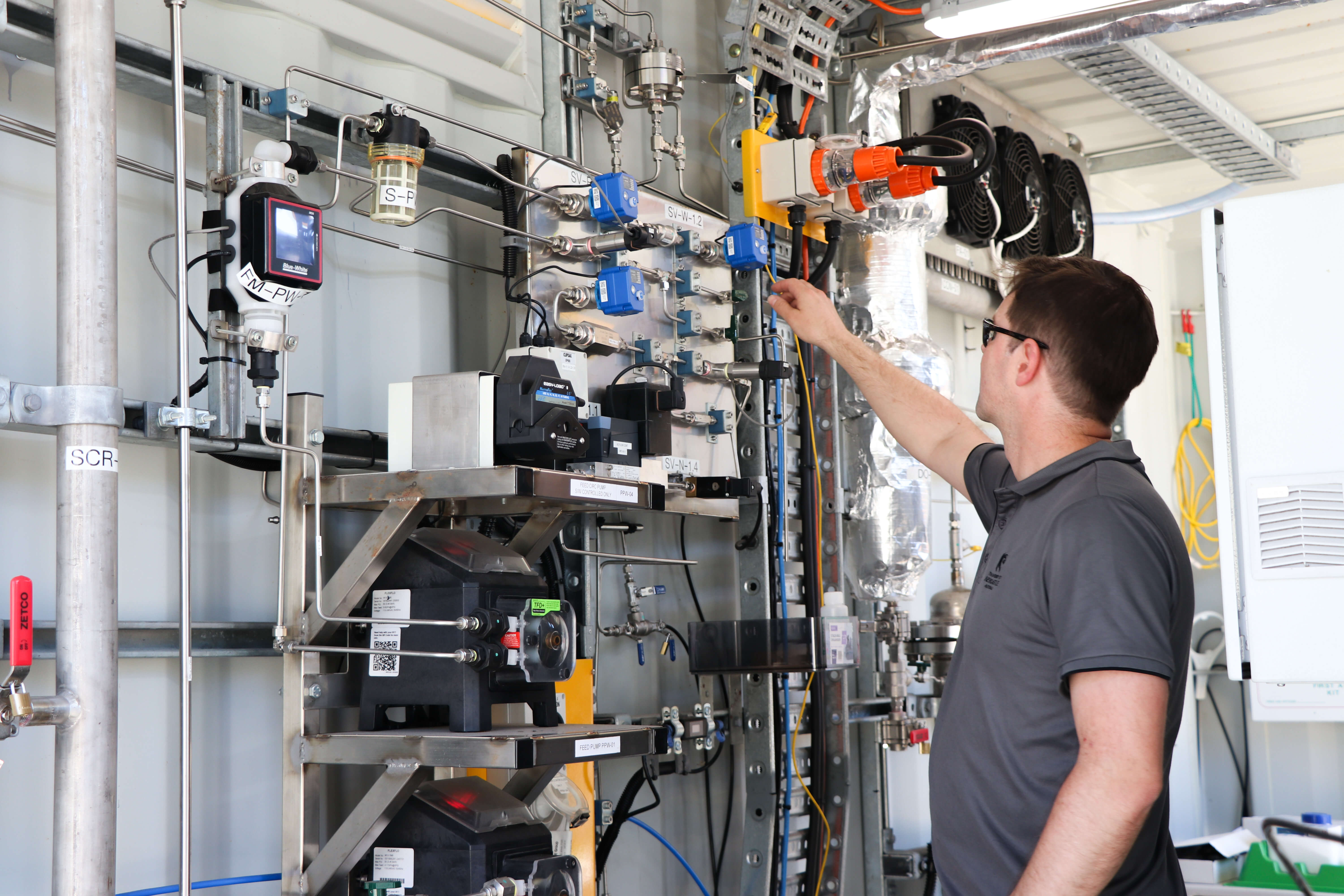
The PFAS Harvester pilot plant (alpha prototype), located at NIER, represents a significant advancement in remediation technology, offering multiple advantages compared to conventional approaches. The PFAS Harvester alpha prototype aims to:
- Achieve complete thermal destruction of PFAS
- Neutralise hazardous by-products through mineralisation
- Deliver a reduced energy footprint and lower emissions through energy recovery, production and utilisation compared to conventional technologies
Designed for practical application, the PFAS Harvester’s containerised design provides plant mobility, enabling access to various sites and locations across Australia. This novel system offers a “bolt-on” solution to complement EVOCRA’s already established primary treatment processes. Together, both processes provide a holistic approach to end-to-end PFAS remediation – from separation through to complete destruction.
“We have adopted a self-contained and mobile plant design to facilitate field trial deployment to various remediation sites,” explained Dr Dickinson.
“Given the capacity of the PFAS Harvester to treat highly concentrated PFAS leachate, we believe this mobile design should offer a cost-effective solution for on-site PFAS destruction across numerous remediation sites where primary treatment processing occurs. In this way, the PFAS contaminate remains on-site without the need for off-site transportation for secondary treatment.”

Supporting a circular economy
Beyond its primary function of PFAS remediation, the PFAS Harvester creates additional value through hydrogen recovery from the treatment process. The system uses a process called Steam Methane Reforming (SMR), utilising treated PFAS water to produce hydrogen-enriched synthesis gas (syngas) – a blend of hydrogen and carbon monoxide.
This syngas offers multiple applications that enhance the system’s sustainability and offset operational costs while supporting a circular economy. A key project objective is to demonstrate and quantify the reduce energy demand and emissions achieved through SMR compared to conventional treatment methods.
Advancing towards deployment
Testing has proven the technical merits of the PFAS Harvester at laboratory scale. Building on this, EVOCRA and the University will use the TRaCE R&D voucher funding to continue testing the alpha prototype. This support will fund a six-month campaign designed to elevate the PFAS Harvester to Technology Readiness Level (TRL) 5, enabling future site demonstrations to commence.
This collaboration between the University of Newcastle and EVOCRA exemplifies how ongoing partnerships between research institutions and industry can accelerate the translation of innovative research into practical solutions. Their work addresses a critical environmental challenge facing the global community.
As the technology advances towards commercial readiness, it offers industries, municipalities and defence facilities a more sustainable, efficient and comprehensive approach to PFAS remediation. By combining effective destruction of forever chemicals with resource recovery and reduced environmental impact and lower carbon footprint, the PFAS Harvester represents the kind of innovation needed to address complex, persistent environmental challenges.
For more information on how you can get involved in the TRaCE program, visit trace.org.au or contact hello@trace.org.au.