Renewable energy sources like solar and wind are abundant, however one of the greatest challenges lies in storing the power they generate. Because output is tied to weather and daylight, supply can be unreliable and mismatched with demand.
Concentrated solar thermal (CST) and other intermittent heat resources offer a compelling solution, if they can be stored. Heat captured from the sun can be released when required, providing a stable and dispatchable source of renewable energy.
FRP Energy is working at the forefront of this innovation, scaling technology that uses ceramic particles to absorb, store, and transfer heat. Unlike other renewable technologies that depend on batteries or operate only during favourable weather conditions, FPR Energy’s technology stores energy as heat and releases it on demand. This makes the technology particularly valuable for processes requiring 24-hour operation. The heat may be transformed to electricity using established thermal power plant technology, leveraging the strong manufacturing and energy generation skillsets available in the Hunter region. In doing so, this technology may not only ensure grid stability by supplying cost effective, zero-emissions energy but also create opportunities for regional expertise to support the clean energy transition.
Looking to bring this technology closer to commercial reality, Dr Anthony Rawson from FPR Energy reached out to Associate Professor Dr Thomas Fiedler and Dr Dylan Cuskelly at the University of Newcastle. Establishing a targeted research program through the TRaCE R&D Voucher initiative, they will investigate how these ceramic particles perform under extreme operating conditions. For successful deployment, the particles should withstand temperatures up to 1200°C while maintaining their heat transfer and thermal storage performance – critical factors for the safety, longevity, and efficiency of the technology.
“The University of Newcastle’s researchers are approachable, professional and enthusiastic. Partnering with Dylan and Thomas was an easy decision, made even easier with the financial support of a TRaCE R&D Voucher,” said Dr Rawson.
“We are excited to partner with FPR Energy on advancing their innovative technology. A renewable energy solution that integrates generation and storage while avoiding the environmental and social challenges of competing approaches aligns perfectly with the University of Newcastle’s engagement priorities.”
– Associate Professor Dr Thomas Fiedler, University of Newcastle
How FPR Energy’s particle-based thermal storage system works
Traditional CST systems work by using mirrors (heliostats) to concentrate sunlight into a targeted location. This produces temperatures normally capped below 600°C when used to heat fluids such as molten salt or oil. These fluids can then be used to heat water to produce steam and power a turbine to generate electricity.
The use of heat transfer fluids in CSTs requires complex heat exchangers that are directly exposed to high temperatures and, more critically, to temperature fluctuations. These fluctuations cause periodic thermal expansion and contraction, which over time can lead to cracking, leakage and ultimately the failure of these components.
FPR Energy’s CST technology works in a similar way, however, to mitigate the issues that can arise from using fluid, they use falling particles instead.
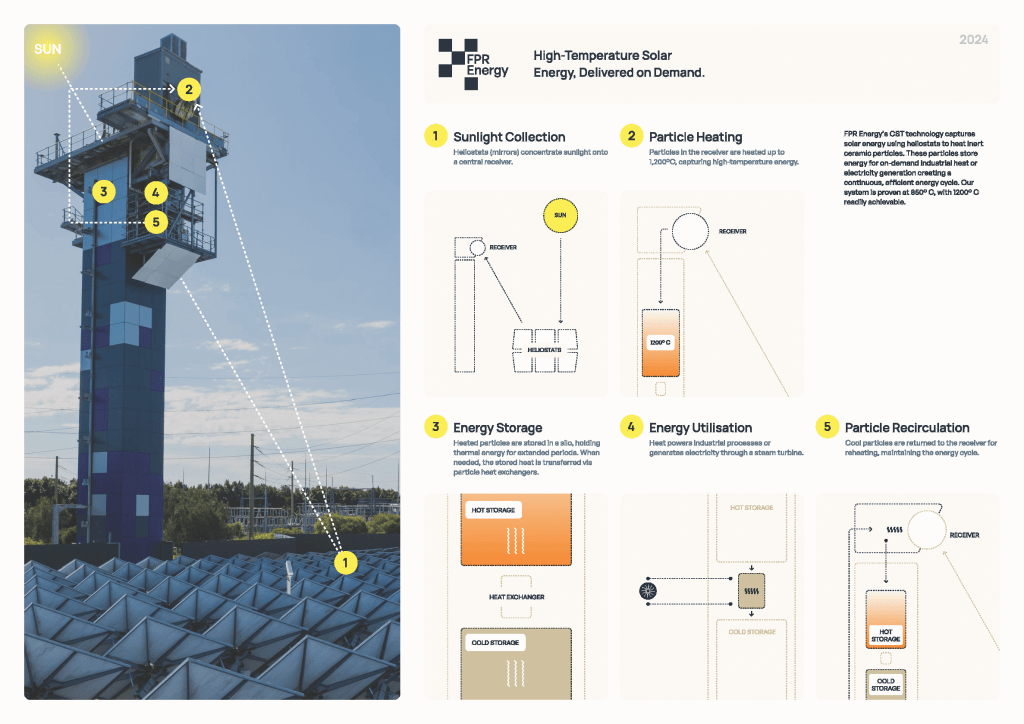
In a CST application, FPR Energy captures solar energy using heliostats that concentrate sunlight onto a central receiver. Through this, a cascade of ceramic particles is heated to temperatures of up to 1200°C, absorbing large amounts of thermal energy.
The heated particles are stored in an insulated silo, where the energy can be held for extended periods. When needed, the particles pass through advanced heat exchangers, transferring their energy for use in industrial processes or to generate electricity via a steam turbine. Once discharged, the particles return to the heat source creating a continuous, efficient cycle.
The CST process is shown in the diagram below.
“Ceramic particles provide an exceptionally safe and stable solution for very high temperature thermal storage and heat transfer,” said Dr Rawson.
“FPR Energy’s unique technology is designed to overcome the energy and power density constraints specific to ceramic media.”
This closed-loop system will provide industry with clean energy solutions that are cost-competitive with fossil fuels while unlocking high-temperature applications that conventional CST and thermal storage systems cannot achieve. Potential applications include:
- Industrial heat for minerals processing, smelting, refining, cement and construction materials, and food manufacturing
- Power generation through advanced cycles, combined heat and power, and integrated overnight storage
- Zero-emission energy to power the production of sustainable e-fuels such as aviation and diesel substitutes, high-temperature electrolysis, and thermal energy storage
Collaboration accelerating clean energy technologies
Beyond the technical outcomes, the project represents a meaningful contribution to global sustainability goals. By reducing reliance on fossil fuels and enabling a stable, low-emission energy grid, CST and thermal storage systems offer a pathway to decarbonisation and grid firming that complements wind, solar panels, and other renewables.
Electricity generation from this technology also leverages existing industry knowledge and skillsets from traditional thermal power plants – an area of particular strength in the Hunter region. This creates opportunities for workforce transition and regional economic resilience while supporting the shift to cleaner energy.
By improving the performance, durability, and efficiency of their ceramic particles, FPR Energy and University of Newcastle researchers are helping unlock that pathway. Their work will support FPR Energy’s CST system in advancing through the TRL 7 stage while also reducing overdesign and providing clarity around inspection and maintenance schedules in future commercial systems.
The TRaCE R&D Voucher plays a vital role in enabling this process. By connecting industry innovators with research expertise and funding, it accelerates the translation of ideas into impact. For FPR Energy, the program strengthens the technical foundation of their commercialisation strategy. For the University of Newcastle team, it provides the opportunity to apply their world-class expertise to a practical, industry-driven challenge with significant social and environmental benefit.
For more information on how you can get involved in the TRaCE program, visit trace.org.au or contact hello@trace.org.au.